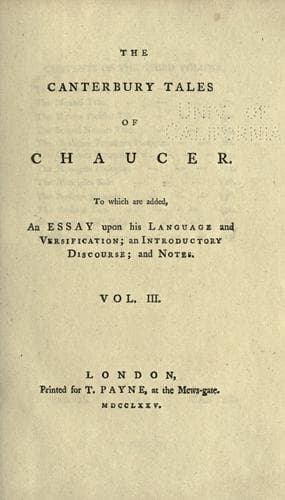
The Canterbury Tales, and Other PoemsChaucer, Geoffrey
ReligionChristian
The Canterbury Tales, and Other Poems
Chaucer, Geoffrey
Chaucer, Geoffrey, -1400; Christian pilgrims and pilgrimages -- Poetry; English poetry -- Middle English, 1100-1500
O sudden hap! O thou fortune unstable!
Like to the scorpion so deceivable,* *deceitful
That fhatt’rest with thy head when thou wilt sting;
Thy tail is death, through thine envenoming.
O brittle joy! O sweete poison quaint!* *strange
O monster, that so subtilly canst paint
Thy giftes, under hue of steadfastness,
That thou deceivest bothe *more and less!* *great and small*
Why hast thou January thus deceiv’d,
That haddest him for thy full friend receiv’d?
And now thou hast bereft him both his eyen,
For sorrow of which desireth he to dien.
Alas! this noble January free,
Amid his lust* and his prosperity *pleasure
Is waxen blind, and that all suddenly.
He weeped and he wailed piteously;
And therewithal the fire of jealousy
(Lest that his wife should fall in some folly)
So burnt his hearte, that he woulde fain,
That some man bothe him and her had slain;
For neither after his death, nor in his life,
Ne would he that she were no love nor wife,
But ever live as widow in clothes black,
Sole as the turtle that hath lost her make.* *mate
But at the last, after a month or tway,
His sorrow gan assuage, soothe to say.
For, when he wist it might none other be,
He patiently took his adversity:
Save out of doubte he may not foregon
That he was jealous evermore-in-one:* *continually
Which jealousy was so outrageous,
That neither in hall, nor in none other house,
Nor in none other place never the mo’
He woulde suffer her to ride or go,
*But if* that he had hand on her alway. *unless
For which full often wepte freshe May,
That loved Damian so burningly
That she must either dien suddenly,
Or elles she must have him as her lest:* *pleased
She waited* when her hearte woulde brest.** *expected **burst
Upon that other side Damian
Becomen is the sorrowfullest man
That ever was; for neither night nor day
He mighte speak a word to freshe May,
As to his purpose, of no such mattere,
*But if* that January must it hear, *unless*
That had a hand upon her evermo’.
But natheless, by writing to and fro,
And privy signes, wist he what she meant,
And she knew eke the fine* of his intent. *end, aim
Public-domain text, read in full here on John Shaqi.
Reviews
Reviews
No reviews yet
Be the first to share your thoughts on this work.
Elsewhere in the archive
Join the Discussion
Join the discussion
Sign in to leave a comment or review.
Sign InorCreate an account