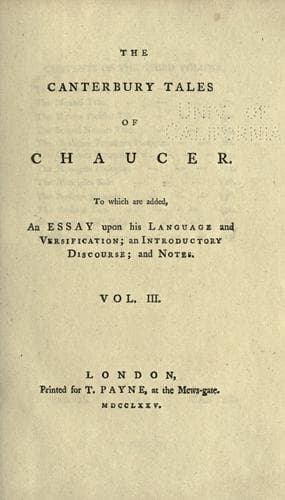
The Canterbury Tales, and Other PoemsChaucer, Geoffrey
ReligionChristian
The Canterbury Tales, and Other Poems
Chaucer, Geoffrey
Chaucer, Geoffrey, -1400; Christian pilgrims and pilgrimages -- Poetry; English poetry -- Middle English, 1100-1500
31. At this point, and again some twenty lines below, several
verses of a very coarse character had been inserted in later
manuscripts; but they are evidently spurious, and are omitted in
the best editions.
32. “Store” is the general reading here, but its meaning is not
obvious. “Stowre” is found in several manuscripts; it signifies
“struggle” or “resist;” and both for its own appropriateness, and
for the force which it gives the word “stronge,” the reading in
the text seems the better.
THE SQUIRE’S TALE.
THE PROLOGUE.
“HEY! Godde’s mercy!” said our Hoste tho,* *then
“Now such a wife I pray God keep me fro’.
Lo, suche sleightes and subtilities
In women be; for aye as busy as bees
Are they us silly men for to deceive,
And from the soothe* will they ever weive,** *truth **swerve, depart
As this Merchante’s tale it proveth well.
But natheless, as true as any steel,
I have a wife, though that she poore be;
But of her tongue a labbing* shrew is she; *chattering
And yet* she hath a heap of vices mo’. *moreover
Thereof *no force;* let all such thinges go. *no matter*
But wit* ye what? in counsel** be it said, *know **secret, confidence
Me rueth sore I am unto her tied;
For, an’* I shoulde reckon every vice *if
Which that she hath, y-wis* I were too nice;** *certainly **foolish
And cause why, it should reported be
And told her by some of this company
(By whom, it needeth not for to declare,
Since women connen utter such chaffare <1>),
And eke my wit sufficeth not thereto
To tellen all; wherefore my tale is do.* *done
Squier, come near, if it your wille be,
And say somewhat of love, for certes ye
*Conne thereon* as much as any man.” *know about it*
“Nay, Sir,” quoth he; “but such thing as I can,
With hearty will, — for I will not rebel
Against your lust,* — a tale will I tell. *pleasure
Have me excused if I speak amiss;
My will is good; and lo, my tale is this.”
Notes to the Prologue to the Squire’s Tale
1. Women connen utter such chaffare: women are adepts at
giving circulation to such wares. The Host evidently means that
his wife would be sure to hear of his confessions from some
female member of the company.
THE TALE.<1>
*Pars Prima.* *First part*
Public-domain text, read in full here on John Shaqi.
Reviews
Reviews
No reviews yet
Be the first to share your thoughts on this work.
Elsewhere in the archive
Join the Discussion
Join the discussion
Sign in to leave a comment or review.
Sign InorCreate an account