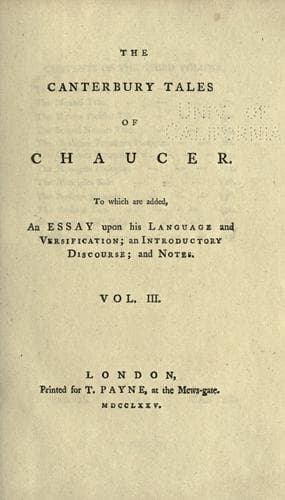
The Canterbury Tales, and Other PoemsChaucer, Geoffrey
ReligionChristian
The Canterbury Tales, and Other Poems
Chaucer, Geoffrey
Chaucer, Geoffrey, -1400; Christian pilgrims and pilgrimages -- Poetry; English poetry -- Middle English, 1100-1500
At after supper went this noble king
To see the horse of brass, with all a rout
Of lordes and of ladies him about.
Such wond’ring was there on this horse of brass,
That, since the great siege of Troye was,
There as men wonder’d on a horse also,
Ne’er was there such a wond’ring as was tho.* *there
But finally the king asked the knight
The virtue of this courser, and the might,
And prayed him to tell his governance.* *mode of managing him
The horse anon began to trip and dance,
When that the knight laid hand upon his rein,
And saide, “Sir, there is no more to sayn,
But when you list to riden anywhere,
Ye muste trill* a pin, stands in his ear, *turn <23>
Which I shall telle you betwixt us two;
Ye muste name him to what place also,
Or to what country that you list to ride.
And when ye come where you list abide,
Bid him descend, and trill another pin
(For therein lies th’ effect of all the gin*), *contrivance <10>
And he will down descend and do your will,
And in that place he will abide still;
Though all the world had the contrary swore,
He shall not thence be throwen nor be bore.
Or, if you list to bid him thennes gon,
Trill this pin, and he will vanish anon
Out of the sight of every manner wight,
And come again, be it by day or night,
When that you list to clepe* him again *call
In such a guise, as I shall to you sayn
Betwixte you and me, and that full soon.
Ride <24> when you list, there is no more to do’n.’
Informed when the king was of the knight,
And had conceived in his wit aright
The manner and the form of all this thing,
Full glad and blithe, this noble doughty king
Repaired to his revel as beforn.
The bridle is into the tower borne,
And kept among his jewels lefe* and dear; *cherished
The horse vanish’d, I n’ot* in what mannere, *know not
Out of their sight; ye get no more of me:
But thus I leave in lust and jollity
This Cambuscan his lordes feastying,* *entertaining <25>
Until well nigh the day began to spring.
*Pars Secunda.* *Second Part*
Public-domain text, read in full here on John Shaqi.
Reviews
Reviews
No reviews yet
Be the first to share your thoughts on this work.
Elsewhere in the archive
Join the Discussion
Join the discussion
Sign in to leave a comment or review.
Sign InorCreate an account