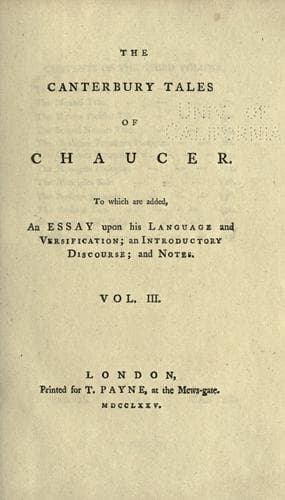
The Canterbury Tales, and Other PoemsChaucer, Geoffrey
ReligionChristian
The Canterbury Tales, and Other Poems
Chaucer, Geoffrey
Chaucer, Geoffrey, -1400; Christian pilgrims and pilgrimages -- Poetry; English poetry -- Middle English, 1100-1500
She gan to look upon Aurelius;
“Is this your will,” quoth she, “and say ye thus?
Ne’er erst,”* quoth she, “I wiste what ye meant: *before
But now, Aurelius, I know your intent.
By thilke* God that gave me soul and life, *that
Never shall I be an untrue wife
In word nor work, as far as I have wit;
I will be his to whom that I am knit;
Take this for final answer as of me.”
But after that *in play* thus saide she. *playfully, in jest*
“Aurelius,” quoth she, “by high God above,
Yet will I grante you to be your love
(Since I you see so piteously complain);
Looke, what day that endelong* Bretagne *from end to end of
Ye remove all the rockes, stone by stone,
That they not lette* ship nor boat to gon, *prevent
I say, when ye have made this coast so clean
Of rockes, that there is no stone seen,
Then will I love you best of any man;
Have here my troth, in all that ever I can;
For well I wot that it shall ne’er betide.
Let such folly out of your hearte glide.
What dainty* should a man have in his life *value, pleasure
For to go love another manne’s wife,
That hath her body when that ever him liketh?”
Aurelius full often sore siketh;* *sigheth
Is there none other grace in you?” quoth he,
“No, by that Lord,” quoth she, “that maked me.
Woe was Aurelius when that he this heard,
And with a sorrowful heart he thus answer’d.
“Madame, quoth he, “this were an impossible.
Then must I die of sudden death horrible.”
And with that word he turned him anon.
Public-domain text, read in full here on John Shaqi.
Reviews
Reviews
No reviews yet
Be the first to share your thoughts on this work.
Elsewhere in the archive
Join the Discussion
Join the discussion
Sign in to leave a comment or review.
Sign InorCreate an account