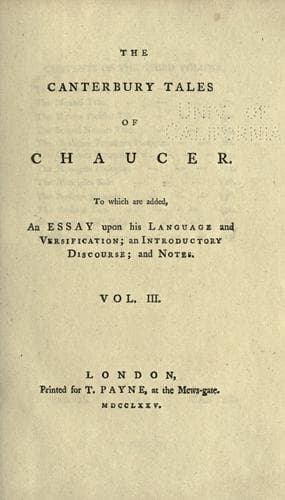
The Canterbury Tales, and Other PoemsChaucer, Geoffrey
ReligionChristian
The Canterbury Tales, and Other Poems
Chaucer, Geoffrey
Chaucer, Geoffrey, -1400; Christian pilgrims and pilgrimages -- Poetry; English poetry -- Middle English, 1100-1500
By which men make divers apparences,
Such as these subtle tregetoures play. *tricksters <14>
For oft at feaste’s have I well heard say,
That tregetours, within a halle large,
Have made come in a water and a barge,
And in the halle rowen up and down.
Sometimes hath seemed come a grim lioun,
And sometimes flowers spring as in a mead;
Sometimes a vine, and grapes white and red;
Sometimes a castle all of lime and stone;
And, when them liked, voided* it anon: *vanished
Thus seemed it to every manne’s sight.
Now then conclude I thus; if that I might
At Orleans some olde fellow find,
That hath these Moone’s mansions in mind,
Or other magic natural above.
He should well make my brother have his love.
For with an appearance a clerk* may make, *learned man
To manne’s sight, that all the rockes blake
Of Bretagne were voided* every one, *removed
And shippes by the brinke come and gon,
And in such form endure a day or two;
Then were my brother warish’d* of his woe, *cured
Then must she needes *holde her behest,* *keep her promise*
Or elles he shall shame her at the least.”
Why should I make a longer tale of this?
Unto his brother’s bed he comen is,
And such comfort he gave him, for to gon
To Orleans, that he upstart anon,
And on his way forth-ward then is he fare,* *gone
In hope for to be lissed* of his care. *eased of <15>
When they were come almost to that city,
*But if it were* a two furlong or three, *all but*
A young clerk roaming by himself they met,
Which that in Latin *thriftily them gret.* *greeted them
And after that he said a wondrous thing; civilly*
I know,” quoth he, “the cause of your coming;”
Aud ere they farther any foote went,
He told them all that was in their intent.
The Breton clerk him asked of fellaws
The which he hadde known in olde daws,* *days
And he answer’d him that they deade were,
For which he wept full often many a tear.
Down off his horse Aurelius light anon,
And forth with this magician is be gone
Home to his house, and made him well at ease;
Them lacked no vitail* that might them please. *victuals, food
So well-array’d a house as there was one,
Aurelius in his life saw never none.
He shewed him, ere they went to suppere,
Forestes, parkes, full of wilde deer.
There saw he hartes with their hornes high,
The greatest that were ever seen with eye.
He saw of them an hundred slain with hounds,
And some with arrows bleed of bitter wounds.
He saw, when voided* were the wilde deer, *passed away
These falconers upon a fair rivere,
That with their hawkes have the heron slain.
Then saw he knightes jousting in a plain.
And after this he did him such pleasance,
That he him shew’d his lady on a dance,
In which himselfe danced, as him thought.
Public-domain text, read in full here on John Shaqi.
Reviews
Reviews
No reviews yet
Be the first to share your thoughts on this work.
Elsewhere in the archive
Join the Discussion
Join the discussion
Sign in to leave a comment or review.
Sign InorCreate an account