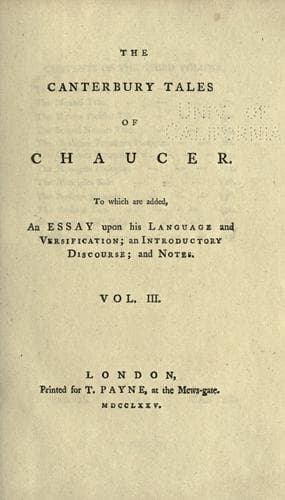
The Canterbury Tales, and Other PoemsChaucer, Geoffrey
ReligionChristian
The Canterbury Tales, and Other Poems
Chaucer, Geoffrey
Chaucer, Geoffrey, -1400; Christian pilgrims and pilgrimages -- Poetry; English poetry -- Middle English, 1100-1500
18. “Noel,” the French for Christmas — derived from “natalis,”
and signifying that on that day Christ was born — came to be
used as a festive cry by the people on solemn occasions.
19. Tables Toletanes: Toledan tables; the astronomical tables
composed by order Of Alphonso II, King of Castile, about 1250
and so called because they were adapted to the city of Toledo.
20. “Alnath,” Says Mr Wright, was “the first star in the horns of
Aries, whence the first mansion of the moon is named.”
21. Another and better reading is “a week or two.”
22. These stories are all taken from the book of St Jerome
“Contra Jovinianum,” from which the Wife of Bath drew so
many of her ancient instances. See note 1 to the prologue to the
Wife of Bath’s Tale.
23. Panthea. Abradatas, King of Susa, was an ally of the
Assyrians against Cyrus; and his wife was taken at the conquest
of the Assyrian camp. Struck by the honourable treatment she
received at the captors hands, Abradatas joined Cyrus, and fell
in battle against his former alhes. His wife, inconsolable at his
loss, slew herself immediately.
24. Protesilaus was the husband of Laedamia. She begged the
gods, after his death, that but three hours’ converse with him
might be allowed her; the request was granted; and when her
dead husband, at the expiry of the time, returned to the world of
shades, she bore him company.
25. The daughter of Cato of Utica, Porcia married Marcus
Brutus, the friend and the assassin of Julius Caesar; when her
husband died by his own hand after the battle of Philippi, she
committed suicide, it is said, by swallowing live coals — all
other means having been removed by her friends.
26. Artemisia, Queen of Caria, who built to her husband
Mausolus, the splendid monument which was accounted among
the wonders of the world; and who mingled her husband’s ashes
with her daily drink. “Barbarie” is used in the Greek sense, to
designate the non-Hellenic peoples of Asia.
27. Teuta: Queen of Illyria, who, after her husband’s death,
made war on and was conquered by the Romans, B.C 228.
28. At this point, in some manuscripts, occur thefollowing two
lines: —
“The same thing I say of Bilia,
Of Rhodegone and of Valeria.”
29. Bound: prepared; going. To “boun” or “bown” is a good
old word, whence comes our word “bound,” in the sense of “on
the way.”
30. That from his lust yet were him lever abide: He would
rather do without his pleasure.
31. Such apparence: such an ocular deception, or apparition —
more properly, disappearance — as the removal of the rocks.
32. The same question is stated a the end of Boccaccio’s version
of the story in the “Philocopo,” where the queen determines in
favour of Aviragus. The question is evidently one of those
which it was the fashion to propose for debate in the mediaeval
“courts of love.”
THE DOCTOR’S TALE.
THE PROLOGUE. <1>
Public-domain text, read in full here on John Shaqi.
Reviews
Reviews
No reviews yet
Be the first to share your thoughts on this work.
Elsewhere in the archive
Join the Discussion
Join the discussion
Sign in to leave a comment or review.
Sign InorCreate an account