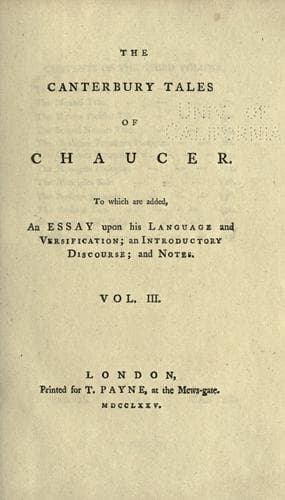
The Canterbury Tales, and Other PoemsChaucer, Geoffrey
ReligionChristian
The Canterbury Tales, and Other Poems
Chaucer, Geoffrey
Chaucer, Geoffrey, -1400; Christian pilgrims and pilgrimages -- Poetry; English poetry -- Middle English, 1100-1500
Tell us some moral thing, that we may lear* *learn
Some wit,* and thenne will we gladly hear.” *wisdom, sense
“I grant y-wis,”* quoth he; “but I must think *surely
Upon some honest thing while that I drink.”
Notes to the Prologue to the Pardoner’s Tale
1. The nails and blood of Christ, by which it was then a fashion
to swear.
2. Mediaeval medical writers; see note 36 to the Prologue to the
Tales.
3. Boist: box; French “boite,” old form “boiste.”
4. Erme: grieve; from Anglo-Saxon, “earme,” wretched.
5. Cardiacle: heartache; from Greek, “kardialgia.”
6. Corpus Domini: God’s body.
7. Corny ale: New and strong, nappy. As to “moist,” see note
39 to the Prologue to the Tales.
8. (Transcriber’s Note)In this scene the pilgrims are refreshing
themselves at tables in front of an inn. The pardoner is drunk,
which explains his boastful and revealing confession of his
deceits.
THE TALE <1>
Lordings (quoth he), in churche when I preach,
I paine me to have an hautein* speech, *take pains **loud <2>
And ring it out, as round as doth a bell,
For I know all by rote that I tell.
My theme is always one, and ever was;
Radix malorum est cupiditas.<3>
First I pronounce whence that I come,
And then my bulles shew I all and some;
Our liege lorde’s seal on my patent,
That shew I first, *my body to warrent,* *for the protection
That no man be so hardy, priest nor clerk, of my person*
Me to disturb of Christe’s holy werk.
And after that then tell I forth my tales.
Bulles of popes, and of cardinales,
Of patriarchs, and of bishops I shew,
And in Latin I speak a wordes few,
To savour with my predication,
And for to stir men to devotion
Then show I forth my longe crystal stones,
Y-crammed fall of cloutes* and of bones; *rags, fragments
Relics they be, as *weene they* each one. *as my listeners think*
Then have I in latoun* a shoulder-bone *brass
Which that was of a holy Jewe’s sheep.
“Good men,” say I, “take of my wordes keep;* *heed
If that this bone be wash’d in any well,
If cow, or calf, or sheep, or oxe swell,
That any worm hath eat, or worm y-stung,
Take water of that well, and wash his tongue,
And it is whole anon; and farthermore
Of pockes, and of scab, and every sore
Shall every sheep be whole, that of this well
Drinketh a draught; take keep* of that I tell. *heed
Public-domain text, read in full here on John Shaqi.
Reviews
Reviews
No reviews yet
Be the first to share your thoughts on this work.
Elsewhere in the archive
Join the Discussion
Join the discussion
Sign in to leave a comment or review.
Sign InorCreate an account