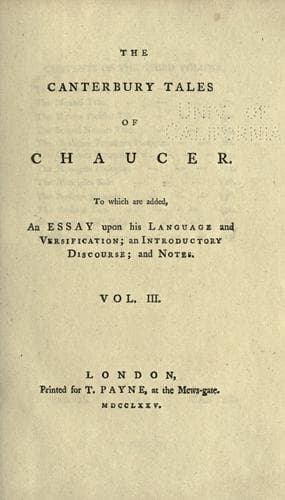
The Canterbury Tales, and Other PoemsChaucer, Geoffrey
ReligionChristian
The Canterbury Tales, and Other Poems
Chaucer, Geoffrey
Chaucer, Geoffrey, -1400; Christian pilgrims and pilgrimages -- Poetry; English poetry -- Middle English, 1100-1500
8. Algesiras was taken from the Moorish king of Grenada, in
1344: the Earls of Derby and Salisbury took part in the siege.
Belmarie is supposed to have been a Moorish state in Africa;
but “Palmyrie” has been suggested as the correct reading. The
Great Sea, or the Greek sea, is the Eastern Mediterranean.
Tramissene, or Tremessen, is enumerated by Froissart among
the Moorish kingdoms in Africa. Palatie, or Palathia, in
Anatolia, was a fief held by the Christian knights after the
Turkish conquests — the holders paying tribute to the infidel.
Our knight had fought with one of those lords against a heathen
neighbour.
9. Ilke: same; compare the Scottish phrase “of that ilk,” —
that is, of the estate which bears the same name as its owner’s
title.
10. It was the custom for squires of the highest degree to carve
at their fathers’ tables.
11. Peacock Arrows: Large arrows, with peacocks’ feathers.
12. A nut-head: With nut-brown hair; or, round like a nut, the
hair being cut short.
13. Grey eyes appear to have been a mark of female beauty in
Chaucer’s time.
14. “for the mastery” was applied to medicines in the sense of
“sovereign” as we now apply it to a remedy.
15. It was fashionable to hang bells on horses’ bridles.
16. St. Benedict was the first founder of a spiritual order in the
Roman church. Maurus, abbot of Fulda from 822 to 842, did
much to re-establish the discipline of the Benedictines on a true
Christian basis.
17. Wood: Mad, Scottish “wud”. Felix says to Paul, “Too
much learning hath made thee mad”.
18. Limitour: A friar with licence or privilege to beg, or
exercise other functions, within a certain district: as, “the
limitour of Holderness”.
19. Farme: rent; that is, he paid a premium for his licence to
beg.
20. In principio: the first words of Genesis and John, employed
in some part of the mass.
21. Lovedays: meetings appointed for friendly settlement of
differences; the business was often followed by sports and
feasting.
22. He would the sea were kept for any thing: he would for
anything that the sea were guarded. “The old subsidy of
tonnage and poundage,” says Tyrwhitt, “was given to the king
‘pour la saufgarde et custodie del mer.’ — for the safeguard and
keeping of the sea” (12 E. IV. C.3).
23. Middleburg, at the mouth of the Scheldt, in Holland;
Orwell, a seaport in Essex.
24. Shields: Crowns, so called from the shields stamped on
them; French, “ecu;” Italian, “scudo.”
25. Poor scholars at the universities used then to go about
begging for money to maintain them and their studies.
26. Parvis: The portico of St. Paul’s, which lawyers frequented
to meet their clients.
27. St Julian: The patron saint of hospitality, celebrated for
supplying his votaries with good lodging and good cheer.
28. Mew: cage. The place behind Whitehall, where the king’s
hawks were caged was called the Mews.
Public-domain text, read in full here on John Shaqi.
Reviews
Reviews
No reviews yet
Be the first to share your thoughts on this work.
Join the Discussion
Join the discussion
Sign in to leave a comment or review.
Sign InorCreate an account