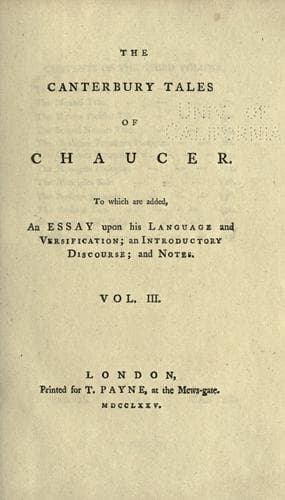
The Canterbury Tales, and Other PoemsChaucer, Geoffrey
ReligionChristian
The Canterbury Tales, and Other Poems
Chaucer, Geoffrey
Chaucer, Geoffrey, -1400; Christian pilgrims and pilgrimages -- Poetry; English poetry -- Middle English, 1100-1500
29. Many a luce in stew: many a pike in his fish-pond; in those
Catholic days, when much fish was eaten, no gentleman’s
mansion was complete without a “stew”.
30. Countour: Probably a steward or accountant in the county
court.
31. Vavasour: A landholder of consequence; holding of a duke,
marquis, or earl, and ranking below a baron.
32. On the dais: On the raised platform at the end of the hall,
where sat at meat or in judgement those high in authority, rank
or honour; in our days the worthy craftsmen might have been
described as “good platform men”.
33. To take precedence over all in going to the evening service
of the Church, or to festival meetings, to which it was the
fashion to carry rich cloaks or mantles against the home-
coming.
34. The things the cook could make: “marchand tart”, some
now unknown ingredient used in cookery; “galingale,” sweet or
long rooted cyprus; “mortrewes”, a rich soup made by stamping
flesh in a mortar; “Blanc manger”, not what is now called
blancmange; one part of it was the brawn of a capon.
35. Lodemanage: pilotage, from Anglo-Saxon “ladman,” a
leader, guide, or pilot; hence “lodestar,” “lodestone.”
36. The authors mentioned here were the chief medical text-
books of the middle ages. The names of Galen and Hippocrates
were then usually spelt “Gallien” and “Hypocras” or “Ypocras”.
37. The west of England, especially around Bath, was the seat
of the cloth-manufacture, as were Ypres and Ghent (Gaunt) in
Flanders.
38. Chaucer here satirises the fashion of the time, which piled
bulky and heavy waddings on ladies’ heads.
39. Moist; here used in the sense of “new”, as in Latin,
“mustum” signifies new wine; and elsewhere Chaucer speaks of
“moisty ale”, as opposed to “old”.
40. In Galice at Saint James: at the shrine of St Jago of
Compostella in Spain.
41. Gat-toothed: Buck-toothed; goat-toothed, to signify her
wantonness; or gap-toothed — with gaps between her teeth.
42. An endowment to sing masses for the soul of the donor.
43. A ram was the usual prize at wrestling matches.
44. Cop: Head; German, “Kopf”.
45. Nose-thirles: nostrils; from the Anglo-Saxon, “thirlian,” to
pierce; hence the word “drill,” to bore.
46. Goliardais: a babbler and a buffoon; Golias was the founder
of a jovial sect called by his name.
47. The proverb says that every honest miller has a thumb of
gold; probably Chaucer means that this one was as honest as his
brethren.
48. A Manciple — Latin, “manceps,” a purchaser or contractor -
- was an officer charged with the purchase of victuals for inns
of court or colleges.
49. Reeve: A land-steward; still called “grieve” — Anglo-Saxon,
“gerefa” in some parts of Scotland.
50. Sompnour: summoner; an apparitor, who cited delinquents
to appear in ecclesiastical courts.
51. Questio quid juris: “I ask which law (applies)”; a cant law-
Latin phrase.
52 Harlot: a low, ribald fellow; the word was used of both
sexes; it comes from the Anglo-Saxon verb to hire.
Public-domain text, read in full here on John Shaqi.
Reviews
Reviews
No reviews yet
Be the first to share your thoughts on this work.
Join the Discussion
Join the discussion
Sign in to leave a comment or review.
Sign InorCreate an account