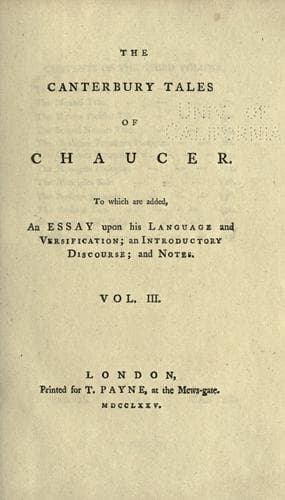
The Canterbury Tales, and Other PoemsChaucer, Geoffrey
ReligionChristian
The Canterbury Tales, and Other Poems
Chaucer, Geoffrey
Chaucer, Geoffrey, -1400; Christian pilgrims and pilgrimages -- Poetry; English poetry -- Middle English, 1100-1500
53. Significavit: an ecclesiastical writ.
54. Within his jurisdiction he had at his own pleasure the young
people (of both sexes) in the diocese.
55. Pardoner: a seller of pardons or indulgences.
56. Newe get: new gait, or fashion; “gait” is still used in this
sense in some parts of the country.
57. Vernicle: an image of Christ; so called from St Veronica,
who gave the Saviour a napkin to wipe the sweat from His face
as He bore the Cross, and received it back with an impression
of His countenance upon it.
58. Mail: packet, baggage; French, “malle,” a trunk.
59. The Bell: apparently another Southwark tavern; Stowe
mentions a “Bull” as being near the Tabard.
60. Cheap: Cheapside, then inhabited by the richest and most
prosperous citizens of London.
61. Herberow: Lodging, inn; French, “Herberge.”
62. The watering of Saint Thomas: At the second milestone on
the old Canterbury road.
THE KNIGHT’S TALE <1>
WHILOM*, as olde stories tellen us, *formerly
There was a duke that highte* Theseus. *was called <2>
Of Athens he was lord and governor,
And in his time such a conqueror
That greater was there none under the sun.
Full many a riche country had he won.
What with his wisdom and his chivalry,
He conquer’d all the regne of Feminie,<3>
That whilom was y-cleped Scythia;
And weddede the Queen Hippolyta
And brought her home with him to his country
With muchel* glory and great solemnity, *great
And eke her younge sister Emily,
And thus with vict’ry and with melody
Let I this worthy Duke to Athens ride,
And all his host, in armes him beside.
And certes, if it n’ere* too long to hear, *were not
I would have told you fully the mannere,
How wonnen* was the regne of Feminie, <4> *won
By Theseus, and by his chivalry;
And of the greate battle for the nonce
Betwixt Athenes and the Amazons;
And how assieged was Hippolyta,
The faire hardy queen of Scythia;
And of the feast that was at her wedding
And of the tempest at her homecoming.
But all these things I must as now forbear.
I have, God wot, a large field to ear* *plough<5>;
And weake be the oxen in my plough;
The remnant of my tale is long enow.
I will not *letten eke none of this rout*. *hinder any of
Let every fellow tell his tale about, this company*
And let see now who shall the supper win.
There *as I left*, I will again begin. *where I left off*
Public-domain text, read in full here on John Shaqi.
Reviews
Reviews
No reviews yet
Be the first to share your thoughts on this work.
Elsewhere in the archive
Join the Discussion
Join the discussion
Sign in to leave a comment or review.
Sign InorCreate an account