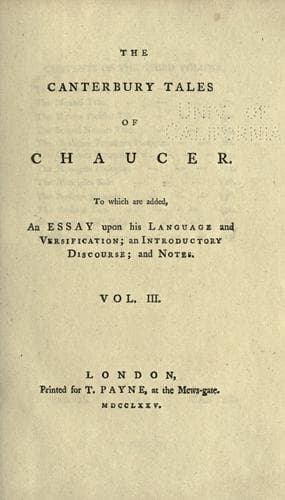
The Canterbury Tales, and Other PoemsChaucer, Geoffrey
ReligionChristian
The Canterbury Tales, and Other Poems
Chaucer, Geoffrey
Chaucer, Geoffrey, -1400; Christian pilgrims and pilgrimages -- Poetry; English poetry -- Middle English, 1100-1500
When that Arcite to Thebes comen was,
Full oft a day he swelt*, and said, “Alas!” *fainted
For see this lady he shall never mo’.
And shortly to concluden all his woe,
So much sorrow had never creature
That is or shall be while the world may dure.
His sleep, his meat, his drink is *him byraft*, *taken away from him*
That lean he wex*, and dry as any shaft. *became
His eyen hollow, grisly to behold,
His hue sallow, and pale as ashes cold,
And solitary he was, ever alone,
And wailing all the night, making his moan.
And if he hearde song or instrument,
Then would he weepen, he might not be stent*. *stopped
So feeble were his spirits, and so low,
And changed so, that no man coulde know
His speech, neither his voice, though men it heard.
And in his gear* for all the world he far’d *behaviour <19>
Not only like the lovers’ malady
Of Eros, but rather y-like manie* *madness
Engender’d of humours melancholic,
Before his head in his cell fantastic.<20>
And shortly turned was all upside down,
Both habit and eke dispositioun,
Of him, this woful lover Dan* Arcite. *Lord <21>
Why should I all day of his woe indite?
When he endured had a year or two
This cruel torment, and this pain and woe,
At Thebes, in his country, as I said,
Upon a night in sleep as he him laid,
Him thought how that the winged god Mercury
Before him stood, and bade him to be merry.
His sleepy yard* in hand he bare upright; *rod <22>
A hat he wore upon his haires bright.
Arrayed was this god (as he took keep*) *notice
As he was when that Argus<23> took his sleep;
And said him thus: “To Athens shalt thou wend*; *go
There is thee shapen* of thy woe an end.” *fixed, prepared
And with that word Arcite woke and start.
“Now truely how sore that e’er me smart,”
Quoth he, “to Athens right now will I fare.
Nor for no dread of death shall I not spare
To see my lady that I love and serve;
In her presence *I recke not to sterve.*” *do not care if I die*
And with that word he caught a great mirror,
And saw that changed was all his colour,
And saw his visage all in other kind.
And right anon it ran him ill his mind,
That since his face was so disfigur’d
Of malady the which he had endur’d,
He mighte well, if that he *bare him low,* *lived in lowly fashion*
Live in Athenes evermore unknow,
And see his lady wellnigh day by day.
And right anon he changed his array,
And clad him as a poore labourer.
And all alone, save only a squier,
That knew his privity* and all his cas**, *secrets **fortune
Which was disguised poorly as he was,
To Athens is he gone the nexte* way. *nearest <24>
And to the court he went upon a day,
And at the gate he proffer’d his service,
To drudge and draw, what so men would devise*. *order
Public-domain text, read in full here on John Shaqi.
Reviews
Reviews
No reviews yet
Be the first to share your thoughts on this work.
Elsewhere in the archive
Join the Discussion
Join the discussion
Sign in to leave a comment or review.
Sign InorCreate an account