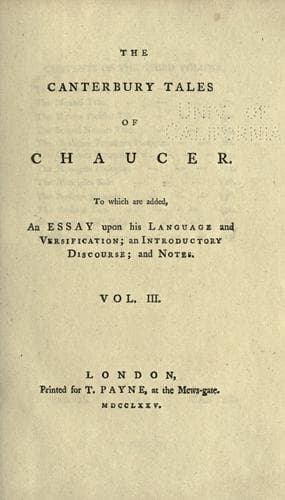
The Canterbury Tales, and Other PoemsChaucer, Geoffrey
ReligionChristian
The Canterbury Tales, and Other Poems
Chaucer, Geoffrey
Chaucer, Geoffrey, -1400; Christian pilgrims and pilgrimages -- Poetry; English poetry -- Middle English, 1100-1500
The fires burn upon the altar clear,
While Emily was thus in her prayere:
But suddenly she saw a sighte quaint*. *strange
For right anon one of the fire’s *queint
And quick’d* again, and after that anon *went out and revived*
That other fire was queint, and all agone:
And as it queint, it made a whisteling,
As doth a brande wet in its burning.
And at the brandes end outran anon
As it were bloody droppes many one:
For which so sore aghast was Emily,
That she was well-nigh mad, and gan to cry,
For she ne wiste what it signified;
But onely for feare thus she cried,
And wept, that it was pity for to hear.
And therewithal Diana gan appear
With bow in hand, right as an hunteress,
And saide; “Daughter, stint* thine heaviness. *cease
Among the goddes high it is affirm’d,
And by eternal word writ and confirm’d,
Thou shalt be wedded unto one of tho* *those
That have for thee so muche care and woe:
But unto which of them I may not tell.
Farewell, for here I may no longer dwell.
The fires which that on mine altar brenn*, *burn
Shall thee declaren, ere that thou go henne*, *hence
Thine aventure of love, as in this case.”
And with that word, the arrows in the case* *quiver
Of the goddess did clatter fast and ring,
And forth she went, and made a vanishing,
For which this Emily astonied was,
And saide; “What amounteth this, alas!
I put me under thy protection,
Diane, and in thy disposition.”
And home she went anon the nexte* way. *nearest
This is th’ effect, there is no more to say.
Public-domain text, read in full here on John Shaqi.
Reviews
Reviews
No reviews yet
Be the first to share your thoughts on this work.
Elsewhere in the archive
Join the Discussion
Join the discussion
Sign in to leave a comment or review.
Sign InorCreate an account