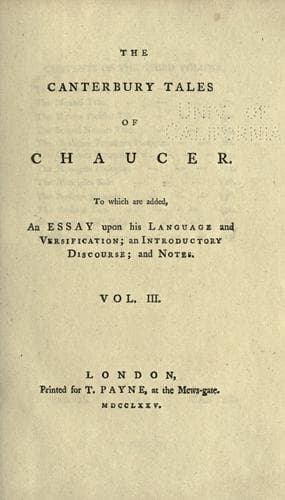
The Canterbury Tales, and Other PoemsChaucer, Geoffrey
ReligionChristian
The Canterbury Tales, and Other Poems
Chaucer, Geoffrey
Chaucer, Geoffrey, -1400; Christian pilgrims and pilgrimages -- Poetry; English poetry -- Middle English, 1100-1500
So was the blood y-run into his face.
Anon he was y-borne out of the place
With hearte sore, to Theseus’ palace.
Then was he carven* out of his harness. *cut
And in a bed y-brought full fair and blive* *quickly
For he was yet in mem’ry and alive,
And always crying after Emily.
Duke Theseus, with all his company,
Is come home to Athens his city,
With alle bliss and great solemnity.
Albeit that this aventure was fall*, *befallen
He woulde not discomforte* them all *discourage
Then said eke, that Arcite should not die,
He should be healed of his malady.
And of another thing they were as fain*. *glad
That of them alle was there no one slain,
All* were they sorely hurt, and namely** one, *although **especially
That with a spear was thirled* his breast-bone. *pierced
To other woundes, and to broken arms,
Some hadden salves, and some hadden charms:
And pharmacies of herbs, and eke save* *sage, Salvia officinalis
They dranken, for they would their lives have.
For which this noble Duke, as he well can,
Comforteth and honoureth every man,
And made revel all the longe night,
Unto the strange lordes, as was right.
Nor there was holden no discomforting,
But as at jousts or at a tourneying;
For soothly there was no discomfiture,
For falling is not but an aventure*. *chance, accident
Nor to be led by force unto a stake
Unyielding, and with twenty knights y-take
One person all alone, withouten mo’,
And harried* forth by armes, foot, and toe, *dragged, hurried
And eke his steede driven forth with staves,
With footmen, bothe yeomen and eke knaves*, *servants
It was *aretted him no villainy:* *counted no disgrace to him*
There may no man *clepen it cowardy*. *call it cowardice*
For which anon Duke Theseus *let cry*, — *caused to be proclaimed*
To stenten* alle rancour and envy, — *stop
The gree* as well on one side as the other, *prize, merit
And either side alike as other’s brother:
And gave them giftes after their degree,
And held a feaste fully dayes three:
And conveyed the kinges worthily
Out of his town a journee* largely *day’s journey
And home went every man the righte way,
There was no more but “Farewell, Have good day.”
Of this bataille I will no more indite
But speak of Palamon and of Arcite.
Public-domain text, read in full here on John Shaqi.
Reviews
Reviews
No reviews yet
Be the first to share your thoughts on this work.
Elsewhere in the archive
Join the Discussion
Join the discussion
Sign in to leave a comment or review.
Sign InorCreate an account