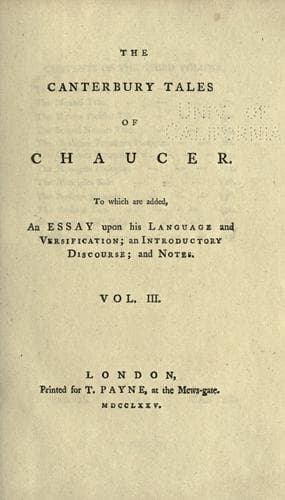
The Canterbury Tales, and Other PoemsChaucer, Geoffrey
ReligionChristian
The Canterbury Tales, and Other Poems
Chaucer, Geoffrey
Chaucer, Geoffrey, -1400; Christian pilgrims and pilgrimages -- Poetry; English poetry -- Middle English, 1100-1500
And with that word his speech to fail began.
For from his feet up to his breast was come
The cold of death, that had him overnome*. *overcome
And yet moreover in his armes two
The vital strength is lost, and all ago*. *gone
Only the intellect, withoute more,
That dwelled in his hearte sick and sore,
Gan faile, when the hearte felte death;
Dusked* his eyen two, and fail’d his breath. *grew dim
But on his lady yet he cast his eye;
His laste word was; “Mercy, Emily!”
His spirit changed house, and wente there,
As I came never I cannot telle where.<84>
Therefore I stent*, I am no divinister**; *refrain **diviner
Of soules find I nought in this register.
Ne me list not th’ opinions to tell
Of them, though that they writen where they dwell;
Arcite is cold, there Mars his soule gie.* *guide
Now will I speake forth of Emily.
Shriek’d Emily, and howled Palamon,
And Theseus his sister took anon
Swooning, and bare her from the corpse away.
What helpeth it to tarry forth the day,
To telle how she wept both eve and morrow?
For in such cases women have such sorrow,
When that their husbands be from them y-go*, *gone
That for the more part they sorrow so,
Or elles fall into such malady,
That at the laste certainly they die.
Infinite be the sorrows and the tears
Of olde folk, and folk of tender years,
In all the town, for death of this Theban:
For him there weepeth bothe child and man.
So great a weeping was there none certain,
When Hector was y-brought, all fresh y-slain,
To Troy: alas! the pity that was there,
Scratching of cheeks, and rending eke of hair.
“Why wouldest thou be dead?” these women cry,
“And haddest gold enough, and Emily.”
No manner man might gladden Theseus,
Saving his olde father Egeus,
That knew this worlde’s transmutatioun,
As he had seen it changen up and down,
Joy after woe, and woe after gladness;
And shewed him example and likeness.
“Right as there died never man,” quoth he,
“That he ne liv’d in earth in some degree*, *rank, condition
Right so there lived never man,” he said,
“In all this world, that sometime be not died.
This world is but a throughfare full of woe,
And we be pilgrims, passing to and fro:
Death is an end of every worldly sore.”
And over all this said he yet much more
To this effect, full wisely to exhort
The people, that they should them recomfort.
Duke Theseus, with all his busy cure*, *care
*Casteth about*, where that the sepulture *deliberates*
Of good Arcite may best y-maked be,
And eke most honourable in his degree.
And at the last he took conclusion,
That there as first Arcite and Palamon
Hadde for love the battle them between,
That in that selve* grove, sweet and green, *self-same
There as he had his amorous desires,
His complaint, and for love his hote fires,
Public-domain text, read in full here on John Shaqi.
Reviews
Reviews
No reviews yet
Be the first to share your thoughts on this work.
Elsewhere in the archive
Join the Discussion
Join the discussion
Sign in to leave a comment or review.
Sign InorCreate an account