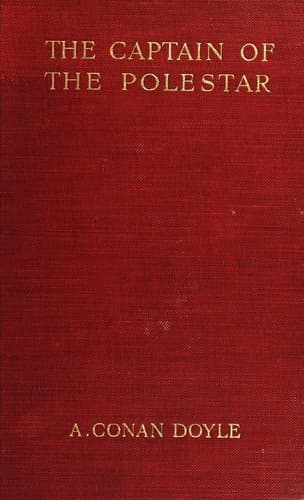
The Captain of the Polestar, and Other TalesDoyle, Arthur Conan
General
The Captain of the Polestar, and Other Tales
Doyle, Arthur Conan
Great Britain -- Social life and customs -- 19th century -- Fiction; Short stories, English
For many weeks John lay in the hospital, and for many weeks efforts were
made to gain some clue as to his antecedents, but in vain. He showed,
as the time rolled by, not only by his demeanour, but also by the
intelligence with which he began to pick up fragments of sentences, like
a clever child learning to talk, that his mind was strong enough in the
present, though it was a complete blank as to the past. The man’s memory
of his whole life before the fatal blow was entirely and absolutely
erased. He neither knew his name, his language, his home, his business,
nor anything else. The doctors held learned consultations upon him,
and discoursed upon the centre of memory and depressed tables, deranged
nerve-cells and cerebral congestions, but all their polysyllables began
and ended at the fact that the man’s memory was gone, and that it was
beyond the power of science to restore it. During the weary months of
his convalescence he picked up reading and writing, but with the return
of his strength came no return of his former life. England, Devonshire,
Brisport, Mary, Granny--the words brought no recollection to his mind.
All was absolute darkness. At last he was discharged, a friendless,
tradeless, penniless man, without a past, and with very little to look
to in the future. His very name was altered, for it had been necessary
to invent one. John Huxford had passed away, and John Hardy took his
place among mankind. Here was a strange outcome of a Spanish gentleman’s
tobacco-inspired meditations.
John’s case had aroused some discussion and curiosity in Quebec, so that
he was not suffered to drift into utter helplessness upon emerging from
the hospital. A Scotch manufacturer named M‘Kinlay found him a post
as porter in his establishment, and for a long time he worked at seven
dollars a week at the loading and unloading of vans. In the course of
years it was noticed, however, that his memory, however defective as
to the past, was extremely reliable and accurate when concerned with
anything which had occurred since his accident. From the factory he was
promoted into the counting-house, and the year 1835 found him a junior
clerk at a salary of L120 a year. Steadily and surely John Hardy fought
his way upward from post to post, with his whole heart and mind devoted
to the business. In 1840 he was third clerk, in 1845 he was second, and
in 1852 he became manager of the whole vast establishment, and second
only to Mr. M‘Kinlay himself.
Public-domain text, read in full here on John Shaqi.
Reviews
Reviews
No reviews yet
Be the first to share your thoughts on this work.
Elsewhere in the archive
Join the Discussion
Join the discussion
Sign in to leave a comment or review.
Sign InorCreate an account