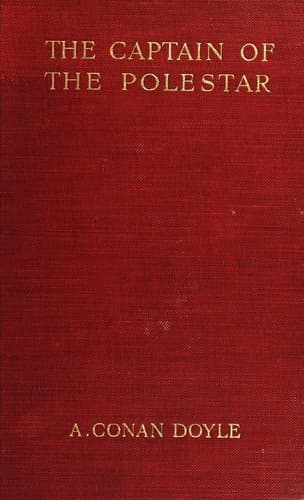
The Captain of the Polestar, and Other TalesDoyle, Arthur Conan
General
The Captain of the Polestar, and Other Tales
Doyle, Arthur Conan
Great Britain -- Social life and customs -- 19th century -- Fiction; Short stories, English
“P.S.--By the way, Northcott did not fall in action. He was killed after
peace was declared in a crazy attempt to get some of the eternal fire
from the sun-worshippers’ temple. There was considerable mystery about
his death.”
I read this epistle over several times--at first with a feeling of
satisfaction, and then with one of disappointment. I had come on some
curious information, and yet hardly what I wanted. He was an eccentric
man, a devil-worshipper, and rumoured to have the power of the evil eye.
I could believe the young lady’s eyes, when endowed with that cold, grey
shimmer which I had noticed in them once or twice, to be capable of any
evil which human eye ever wrought; but still the superstition was
an effete one. Was there not more meaning in that sentence which
followed--“He had theories of the power of the human will and of the
effect of mind upon matter”? I remember having once read a quaint
treatise, which I had imagined to be mere charlatanism at the time, of
the power of certain human minds, and of effects produced by them at a
distance.
Was Miss Northcott endowed with some exceptional power of the sort?
The idea grew upon me, and very shortly I had evidence which convinced
me of the truth of the supposition.
It happened that at the very time when my mind was dwelling upon this
subject, I saw a notice in the paper that our town was to be visited by
Dr. Messinger, the well-known medium and mesmerist. Messinger was a man
whose performance, such as it was, had been again and again pronounced
to be genuine by competent judges. He was far above trickery, and had
the reputation of being the soundest living authority upon the strange
pseudo-sciences of animal magnetism and electro-biology. Determined,
therefore, to see what the human will could do, even against all the
disadvantages of glaring footlights and a public platform, I took a
ticket for the first night of the performance, and went with several
student friends.
We had secured one of the side boxes, and did not arrive until after the
performance had begun. I had hardly taken my seat before I recognised
Barrington Cowles, with his fiancee and old Mrs. Merton, sitting in the
third or fourth row of the stalls. They caught sight of me at almost
the same moment, and we bowed to each other. The first portion of the
lecture was somewhat commonplace, the lecturer giving tricks of pure
legerdemain, with one or two manifestations of mesmerism, performed
upon a subject whom he had brought with him. He gave us an exhibition of
clairvoyance too, throwing his subject into a trance, and then demanding
particulars as to the movements of absent friends, and the whereabouts
of hidden objects all of which appeared to be answered satisfactorily.
I had seen all this before, however. What I wanted to see now was the
effect of the lecturer’s will when exerted upon some independent member
of the audience.
Public-domain text, read in full here on John Shaqi.
Reviews
Reviews
No reviews yet
Be the first to share your thoughts on this work.
Elsewhere in the archive
Join the Discussion
Join the discussion
Sign in to leave a comment or review.
Sign InorCreate an account