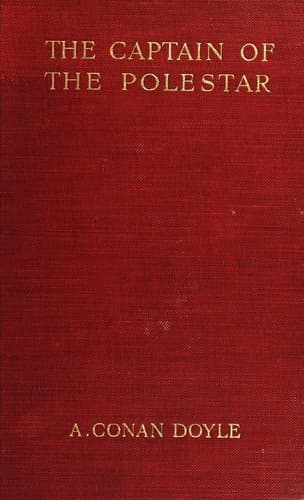
The Captain of the Polestar, and Other TalesDoyle, Arthur Conan
General
The Captain of the Polestar, and Other Tales
Doyle, Arthur Conan
Great Britain -- Social life and customs -- 19th century -- Fiction; Short stories, English
“About?” he groaned, covering his face with his hands. “If I did
tell you, Bob, you would not believe it. It is too dreadful--too
horrible--unutterably awful and incredible! O Kate, Kate!” and he rocked
himself to and fro in his grief; “I pictured you an angel and I find you
a----”
“A what?” I asked, for he had paused.
He looked at me with a vacant stare, and then suddenly burst out, waving
his arms: “A fiend!” he cried. “A ghoul from the pit! A vampire soul
behind a lovely face! Now, God forgive me!” he went on in a lower tone,
turning his face to the wall; “I have said more than I should. I have
loved her too much to speak of her as she is. I love her too much now.”
He lay still for some time, and I had hoped that the brandy had had the
effect of sending him to sleep, when he suddenly turned his face towards
me.
“Did you ever read of wehr-wolves?” he asked.
I answered that I had.
“There is a story,” he said thoughtfully, “in one of Marryat’s books,
about a beautiful woman who took the form of a wolf at night and
devoured her own children. I wonder what put that idea into Marryat’s
head?”
He pondered for some minutes, and then he cried out for some more
brandy. There was a small bottle of laudanum upon the table, and I
managed, by insisting upon helping him myself, to mix about half a
drachm with the spirits. He drank it off, and sank his head once more
upon the pillow. “Anything better than that,” he groaned. “Death is
better than that. Crime and cruelty; cruelty and crime. Anything is
better than that,” and so on, with the monotonous refrain, until at last
the words became indistinct, his eyelids closed over his weary eyes, and
he sank into a profound slumber. I carried him into his bedroom without
arousing him; and making a couch for myself out of the chairs, I
remained by his side all night.
In the morning Barrington Cowles was in a high fever. For weeks he
lingered between life and death. The highest medical skill of Edinburgh
was called in, and his vigorous constitution slowly got the better of
his disease. I nursed him during this anxious time; but through all his
wild delirium and ravings he never let a word escape him which explained
the mystery connected with Miss Northcott. Sometimes he spoke of her
in the tenderest words and most loving voice. At others he screamed out
that she was a fiend, and stretched out his arms, as if to keep her off.
Several times he cried that he would not sell his soul for a beautiful
face, and then he would moan in a most piteous voice, “But I love her--I
love her for all that; I shall never cease to love her.”
Public-domain text, read in full here on John Shaqi.
Reviews
Reviews
No reviews yet
Be the first to share your thoughts on this work.
Elsewhere in the archive
Join the Discussion
Join the discussion
Sign in to leave a comment or review.
Sign InorCreate an account