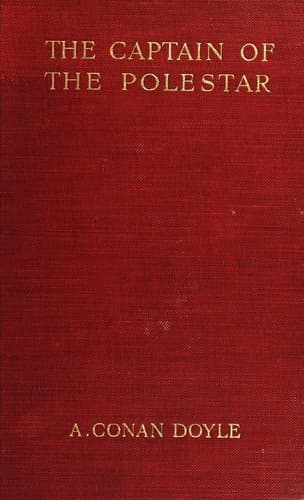
The Captain of the Polestar, and Other TalesDoyle, Arthur Conan
General
The Captain of the Polestar, and Other Tales
Doyle, Arthur Conan
Great Britain -- Social life and customs -- 19th century -- Fiction; Short stories, English
Communication between Jackman’s Gulch and the outside world was
difficult and uncertain. A portion of the bush between it and Ballarat
was infested by a redoubtable outlaw named Conky Jim, who, with a small
band as desperate as himself, made travelling a dangerous matter. It
was customary, therefore, at the Gulch, to store up the dust and nuggets
obtained from the mines in a special store, each man’s share being
placed in a separate bag on which his name was marked. A trusty man,
named Woburn, was deputed to watch over this primitive bank. When the
amount deposited became considerable, a waggon was hired, and the
whole treasure was conveyed to Ballarat, guarded by the police and by
a certain number of miners, who took it in turn to perform the office.
Once in Ballarat, it was forwarded on to Melbourne by the regular gold
waggons. By this plan the gold was often kept for months in the Gulch
before being despatched, but Conky Jim was effectually checkmated, as
the escort party were far too strong for him and his gang. He appeared,
at the time of which I write, to have forsaken his haunts in disgust,
and the road could be traversed by small parties with impunity.
Comparative order used to reign during the daytime at Jackman’s Gulch,
for the majority of the inhabitants were out with crowbar and pick among
the quartz ledges, or washing clay and sand in their cradles by the
banks of the little stream. As the sun sank down, however, the claims
were gradually deserted, and their unkempt owners, clay-bespattered and
shaggy, came lounging into camp, ripe for any form of mischief. Their
first visit was to Woburn’s gold store, where their clean-up of the day
was duly deposited, the amount being entered in the storekeeper’s book,
and each miner retaining enough to cover his evening’s expenses. After
that, all restraint was at an end, and each set to work to get rid
of his surplus dust with the greatest rapidity possible. The focus of
dissipation was the rough bar, formed by a couple of hogsheads spanned
by planks, which was dignified by the name of the “Britannia Drinking
Saloon.” Here Nat Adams, the burly bar-keeper, dispensed bad whisky
at the rate of two shillings a noggin, or a guinea a bottle, while his
brother Ben acted as croupier in a rude wooden shanty behind, which had
been converted into a gambling hell, and was crowded every night. There
had been a third brother, but an unfortunate misunderstanding with a
customer had shortened his existence. “He was too soft to live long,”
his brother Nathaniel feelingly observed, on the occasion of his
funeral. “Many’s the time I’ve said to him, ‘If you’re arguin’ a pint
with a stranger, you should always draw first, then argue, and then
shoot, if you judge that he’s on the shoot.’ Bill was too purlite.
He must needs argue first and draw after, when he might just as well
have kivered his man before talkin’ it over with him.” This amiable
weakness of the deceased Bill was a blow to the firm of Adams, which
Public-domain text, read in full here on John Shaqi.
Reviews
Reviews
No reviews yet
Be the first to share your thoughts on this work.
Elsewhere in the archive
Join the Discussion
Join the discussion
Sign in to leave a comment or review.
Sign InorCreate an account