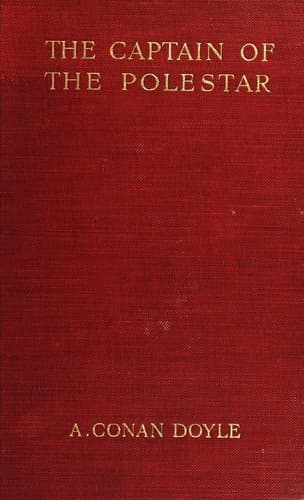
The Captain of the Polestar, and Other TalesDoyle, Arthur Conan
General
The Captain of the Polestar, and Other Tales
Doyle, Arthur Conan
Great Britain -- Social life and customs -- 19th century -- Fiction; Short stories, English
Adams’ saloon was a substantial wooden building in the rear of the
bar, which was used partly for storing liquor and partly for a gambling
saloon. It was strongly built of rough-hewn logs, the proprietor rightly
judging, in the unregenerate days of Jackman’s Gulch, that hogsheads of
brandy and rum were commodities which had best be secured under lock and
key. A strong door opened into each end of the saloon, and the interior
was spacious enough, when the table and lumber were cleared away,
to accommodate the whole population. The spirit barrels were heaped
together at one end by their owner, so as to make a very fair imitation
of a pulpit.
At first the Gulch took but a mild interest in the proceedings, but
when it became known that Elias B. Hopkins intended, after reading the
service, to address the audience, the settlement began to warm up to
the occasion. A real sermon was a novelty to all of them, and one coming
from their own parson was additionally so. Rumour announced that it
would be interspersed with local hits, and that the moral would be
pointed by pungent personalities. Men began to fear that they would be
unable to gain seats, and many applications were made to the brothers
Adams. It was only when conclusively shown that the saloon could contain
them all with a margin that the camp settled down into calm expectancy.
It was as well that the building was of such a size, for the assembly
upon the Sunday morning was the largest which had ever occurred in
the annals of Jackman’s Gulch. At first it was thought that the whole
population was present, but a little reflection showed that this was
not so. Maule and Phillips had gone on a prospecting journey among the
hills, and had not returned as yet, and Woburn, the gold-keeper, was
unable to leave his store. Having a very large quantity of the
precious metal under his charge, he stuck to his post, feeling that the
responsibility was too great to trifle with. With these three exceptions
the whole of the Gulch, with clean red shirts, and such other additions
to their toilet as the occasion demanded, sauntered in a straggling line
along the clayey pathway which led up to the saloon.
The interior of the building had been provided with rough benches, and
the parson, with his quiet good-humoured smile, was standing at the door
to welcome them. “Good morning, boys,” he cried cheerily, as each group
came lounging up. “Pass in; pass in. You’ll find this is as good a
morning’s work as any you’ve done. Leave your pistols in this barrel
outside the door as you pass; you can pick them out as you come out
again, but it isn’t the thing to carry weapons into the house of peace.”
His request was good-humouredly complied with, and before the last of
the congregation filed in, there was a strange assortment of knives
and firearms in this depository. When all had assembled, the doors
were shut, and the service began--the first and the last which was ever
performed at Jackman’s Gulch.
Public-domain text, read in full here on John Shaqi.
Reviews
Reviews
No reviews yet
Be the first to share your thoughts on this work.
Elsewhere in the archive
Join the Discussion
Join the discussion
Sign in to leave a comment or review.
Sign InorCreate an account