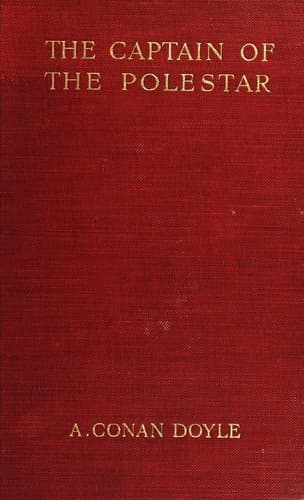
The Captain of the Polestar, and Other TalesDoyle, Arthur Conan
General
The Captain of the Polestar, and Other Tales
Doyle, Arthur Conan
Great Britain -- Social life and customs -- 19th century -- Fiction; Short stories, English
“With a sinking heart and a sad foreboding of evil I left her with her
tirewomen. In the morning, when the early sacrifice was over, I hurried
to her house. A frightened slave met me upon the steps. Her mistress
was ill, she said, very ill. In a frenzy I broke my way through the
attendants, and rushed through hall and corridor to my Atma’s chamber.
She lay upon her couch, her head high upon the pillow, with a pallid
face and a glazed eye. On her forehead there blazed a single angry
purple patch. I knew that hell-mark of old. It was the scar of the white
plague, the sign-manual of death.
“Why should I speak of that terrible time? For months I was mad,
fevered, delirious, and yet I could not die. Never did an Arab thirst
after the sweet wells as I longed after death. Could poison or steel
have shortened the thread of my existence, I should soon have rejoined
my love in the land with the narrow portal. I tried, but it was of no
avail. The accursed influence was too strong upon me. One night as I lay
upon my couch, weak and weary, Parmes, the priest of Thoth, came to my
chamber. He stood in the circle of the lamplight, and he looked down
upon me with eyes which were bright with a mad joy.
“‘Why did you let the maiden die?’ he asked; ‘why did you not strengthen
her as you strengthened me?’
“‘I was too late,’ I answered. ‘But I had forgot. You also loved her.
You are my fellow in misfortune. Is it not terrible to think of the
centuries which must pass ere we look upon her again? Fools, fools, that
we were to take death to be our enemy!’
“‘You may say that,’ he cried with a wild laugh; ‘the words come well
from your lips. For me they have no meaning.’
“‘What mean you?’ I cried, raising myself upon my elbow. ‘Surely,
friend, this grief has turned your brain.’ His face was aflame with joy,
and he writhed and shook like one who hath a devil.
“‘Do you know whither I go?’ he asked.
“‘Nay,’ I answered, ‘I cannot tell.’
“‘I go to her,’ said he. ‘She lies embalmed in the further tomb by the
double palm-tree beyond the city wall.’
“‘Why do you go there?’ I asked.
“‘To die!’ he shrieked, ‘to die! I am not bound by earthen fetters.’
“‘But the elixir is in your blood,’ I cried.
“‘I can defy it,’ said he; ‘I have found a stronger principle which will
destroy it. It is working in my veins at this moment, and in an hour I
shall be a dead man. I shall join her, and you shall remain behind.’
“As I looked upon him I could see that he spoke words of truth. The
light in his eye told me that he was indeed beyond the power of the
elixir.
“‘You will teach me!’ I cried.
“‘Never!’ he answered.
“‘I implore you, by the wisdom of Thoth, by the majesty of Anubis!’
“‘It is useless,’ he said coldly.
“‘Then I will find it out,’ I cried.
“‘You cannot,’ he answered; ‘it came to me by chance. There is one
ingredient which you can never get. Save that which is in the ring of
Thoth, none will ever more be made.
Public-domain text, read in full here on John Shaqi.
Reviews
Reviews
No reviews yet
Be the first to share your thoughts on this work.
Elsewhere in the archive
Join the Discussion
Join the discussion
Sign in to leave a comment or review.
Sign InorCreate an account