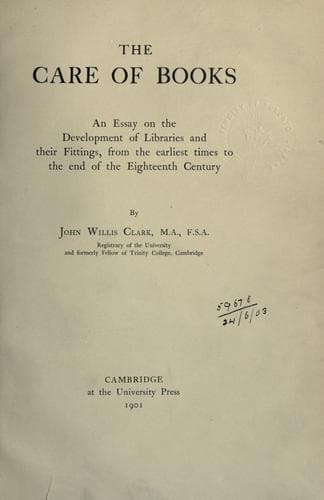
Libraries -- History; Library architecture -- History; Library fittings and supplies -- History
THE FITTINGS OF MONASTIC LIBRARIES AND OF COLLEGIATE LIBRARIES PROBABLY
IDENTICAL. ANALYSIS OF SOME LIBRARY-STATUTES. MONASTIC INFLUENCE AT THE
UNIVERSITIES. NUMBER OF BOOKS OWNED BY COLLEGES. THE COLLEGIATE LIBRARY.
BISHOP COBHAM'S LIBRARY AT OXFORD. LIBRARY AT QUEENS' COLLEGE, CAMBRIDGE.
AT ZUTPHEN. THE LECTERN SYSTEM. CHAINING OF BOOKS. FURTHER EXAMPLES AND
ILLUSTRATIONS.
How were the libraries mentioned in the preceding chapter fitted up? For
instance, what manner of bookcases did Archbishop Chichele put into his
library at Canterbury in 1414, or the "bons ouvriers subtilz et plains de
sens" supply to the Abbat of Clairvaux in 1496? The primitive book-presses
have long ago been broken up; and the medieval devices that succeeded them
have had no better fate. This dearth of material need not, however,
discourage us. We have, I think, the means of discovering with tolerable
certainty what monastic fittings must have been, by comparing the
bookcases which still exist in a more or less perfect form in the
libraries of Oxford and Cambridge with such monastic catalogues as give
particulars of arrangement and not merely lists of books.
The collegiate system was in no sense monastic, indeed it was to a certain
extent established to counteract monastic influence; but it is absurd to
suppose that the younger communities would borrow nothing from the
elder--especially when we reflect that the monastic system, as inaugurated
by S. Benedict, had completed at least seven centuries of successful
existence before Walter de Merton was moved to found a college, and that
many of the subsequent founders of colleges were more or less closely
connected with monasteries. Further, as we have seen that study was
specially enjoined upon monks by S. Benedict, it is precisely in the
direction of study that we might expect to find features common to the two
sets of communities. And, in fact, an examination of the statutes
affecting the library in the codes imposed upon some of the earlier
colleges at Oxford and Cambridge, leads us irresistibly to the conclusion
that they were derived from monastic Customs, using the word in its
technical sense, and monastic practice. The resemblances are too striking
to be accidental.
I shall therefore, in the next place, review, as briefly as I can, the
statutes of some of the above colleges, taking them in chronological
order[258]; and I shall translate some passages from them.
Public-domain text, read in full here on John Shaqi.
Reviews
Reviews
No reviews yet
Be the first to share your thoughts on this work.
Elsewhere in the archive
Join the Discussion
Join the discussion
Sign in to leave a comment or review.
Sign InorCreate an account