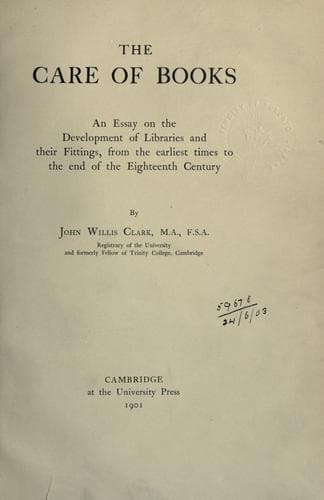
Libraries -- History; Library architecture -- History; Library fittings and supplies -- History
The common books (_communes libri_) of the House are to
be brought out and inspected once a year, on the feast
of the Commemoration of Souls [2 November], in presence
of the Provost or his deputy, and of the Scholars
[Fellows].
Every one of them in turn, in order of seniority, may
select a single book which either treats of the science
to which he is devoting himself, or which he requires
for his use. This he may keep, if he please, until the
same festival in the succeeding year, when a similar
selection of books is to take place, and so on, from
year to year.
If there should happen to be more books than persons,
those that remain are to be selected in the same
manner[263].
The last clause plainly shews how small the number of the books must have
been when the statute was written. Their safety was subsequently secured
by an ordinance of the Provost and Scholars, which, by decree of the
Visitor, dated 13 May, 1441, received the authority of a statute. The high
value set upon the books is shewn by the extreme stringency of the
penalties imposed for wilful loss or failure of restitution. After
describing the annual assemblage of the Provost and Fellows, as directed
in the former statute, the new enactment proceeds as follows:
Any person who absents himself on that day, so that the
books selected by him are neither produced nor restored;
or who, being present, refuses to produce or to restore
them; or who refuses to pay the full value, if, without
any fraud or deception on his part, it should happen
that any one of them be missing; is to be deprived of
all right of selecting books for that year; and any
person who wittingly defers the aforesaid production or
restitution till Christmas next ensuing, shall, _ipso
facto_, cease to be a Fellow.
Further, any scholar who has pawned or alienated,
contrary to the common consent of the college, any book
or object of value (_jocale_) belonging to the college;
or who has even suggested, helped, or favoured, such
pawning or alienation, shall, _ipso facto_, cease to be
a member of the Society[264].
The statutes of Peterhouse, Cambridge, dated 1344, class the books of the
Society with the charters and the muniments, and prescribe the following
rules for their safe custody:
In order that the books which are the common property of
the House (_communes libri_), the charters, and the
muniments, may be kept in safe custody, we appoint and
ordain that an indenture be drawn up of the whole of
them in the presence of at least the major part of the
scholars, expressing what the books are, and to what
faculty they belong; of which indenture one part is to
be deposited with the Master, the other with the Deans,
as a record of the transaction.
Public-domain text, read in full here on John Shaqi.
Reviews
Reviews
No reviews yet
Be the first to share your thoughts on this work.
Elsewhere in the archive
Join the Discussion
Join the discussion
Sign in to leave a comment or review.
Sign InorCreate an account