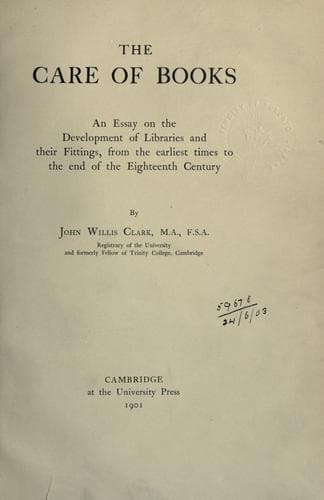
Libraries -- History; Library architecture -- History; Library fittings and supplies -- History
The Governors shall the first day of every quarter when
they come to the School take an account of all such
books as have been given to the School, and if any be
picked away torn or written in they shall cause him that
so misused it to buy another book as good and lay it in
the place of it and there to be used continually as
others be.
The Schoolmaster and Usher whensoever the Scholars go
from the School shall cause all such books as have been
or shall be given to the School and occupied abroad that
day to be brought into the place appointed for them, and
there to be locked up; and every morning shall cause the
dictionaries, or such other books as are meet to be
occupied abroad by the Scholars, that have none of their
own, to be laid abroad, and see that none use to write
in them, pull out leaves, nor carry them from the
School; and if any misuse any book, or pick it away, the
Governours shall cause him to buy another as good, to be
laid in the stead of it, and occupied as the other was.
And for the books of divinity, the Schoolmaster and
Usher and such as give themselves to study divinity,
shall occupy them, that they may be the more able to
declare any article of the catechism or religion to the
scholars; and in the church to make some notes of the
Chapters that be read that the people may better
understand them and remember what is read. And yet these
books they shall not carry out of the School, without
license of the Governours, and on pain to bring it
again, or else to buy one as good, in its stead, and to
be allowed out of the Master's or Usher's wages.
If any preacher come and desire to have the use of some
of those books, they shall let him have the use of them
for a time so that they see them brought in again; none
other shall carry them from the School except they have
license of half the Governours and be bound to bring it
safe again.
In 1573 John Parkhurst, Bishop of Norwich (1560-1575), bequeathed "the
most part" of his Latin books to his native town Guildford, to be placed
in "the Lybrarie of the same Towne ioyning to the Schole." These books,
after some legal difficulties had been overcome, were brought to
Guildford, and placed in a gallery which connected the two wings of the
school, and had been begun in 1571. The books were fastened to the shelves
with chains, one of which has been already figured (fig. 58). There is
evidence that the library was well cared for, and augmented by various
donations, which were regularly chained as they came in, down to the end
of the 17th century[474].
Henry Bury, founder of the free school at Bury in Lancashire in 1625,
directed in his will that a convenient place should be found for the
library, because, as he proceeds to say:
Public-domain text, read in full here on John Shaqi.
Reviews
Reviews
No reviews yet
Be the first to share your thoughts on this work.
Elsewhere in the archive
Join the Discussion
Join the discussion
Sign in to leave a comment or review.
Sign InorCreate an account