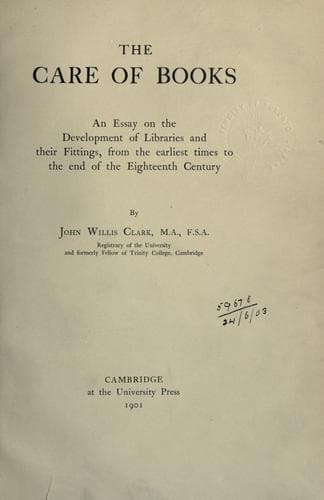
Libraries -- History; Library architecture -- History; Library fittings and supplies -- History
When we try to realise the feelings with which monastic communities
regarded books, it must always be remembered that they had a paternal
interest in them. In many cases they had been written in the very House in
which they were afterwards read from generation to generation: and if not,
they had probably been procured by the exchange of some work so written.
In fact, if a book was not a son of the House, it was at least a nephew.
The conviction that books were a possession with which no convent could
dispense, appears in many medieval writers. The whole matter is summed up
in the phrase, written about 1170, "claustrum sine armario, castrum sine
armamentario[150]," an epigram which I will not spoil by trying to
translate it; and even more clearly in the passionate utterances of Thomas
a Kempis on the desolate condition of priest and convent without
books[151]. The "round of creation" is explored for similes to enforce
this truth. A priest so situated is like a horse without bridle, a ship
without oars, a writer without pens, a bird without wings, etc.; while the
House is like a kitchen without stewpans, a table without food, a well
without water, a river without fish--and many other things which I have no
space to mention.
Evidence of the solicitude with which they protected their treasures is
not wanting. The very mode of holding a manuscript was prescribed, if not
by law, at least by general custom. "When the religious are engaged in
reading in cloister or in church," says an Order of the General
Benedictine Chapter, "they shall if possible hold the books in their left
hands, wrapped in the sleeve of their tunics, and resting on their knees;
their right hands shall be uncovered with which to hold and turn the
leaves of the aforesaid books[152]." In a manuscript at Monte Cassino[153]
is the practical injunction
Quisquis quem tetigerit
Sit illi lota manus;
and at the same House the possession of handkerchiefs--which were
evidently regarded as effeminate inventions--is specially excused on the
ground that they would be useful--among other things--"for wrapping round
the manuscripts which brethren handle[154]." Of similar import is the
distich at the end of a fine manuscript formerly in the library of S.
Victor:
Qui servare libris preciosis nescit honorem
Illius a manibus sit procul iste liber[155].
With these injunctions may be compared a note in a fourteenth century
manuscript from the same library:
Whoever pursues his studies in this book, should be
careful to handle the leaves gently and delicately, so
as to avoid tearing them by reason of their thinness;
and let him imitate the example of Jesus Christ, who,
when he had quietly opened the book of Isaiah and read
therein attentively, rolled it up with reverence, and
gave it again to the minister[156];
Public-domain text, read in full here on John Shaqi.
Reviews
Reviews
No reviews yet
Be the first to share your thoughts on this work.
Elsewhere in the archive
Join the Discussion
Join the discussion
Sign in to leave a comment or review.
Sign InorCreate an account