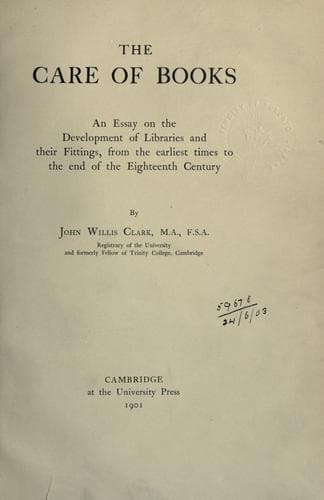
Libraries -- History; Library architecture -- History; Library fittings and supplies -- History
The cloister at Durham, or at least that part of it which was used as a
library, was glazed; but whether with white glass or stained glass we are
not informed. So obvious a device for increasing both the comfort and the
beauty of a much-frequented part of the monastic buildings was doubtless
adopted in many other Houses. At Bury S. Edmunds part at least of the
cloister had "painted windows representing the sun, moon and stars and the
occupations of the months"; at Christ Church, Canterbury, Prior Sellyng
(1472-94) "had the south walk of the cloister glazed for the use of the
studious brethren"; at Peterborough the windows of the cloister
were all compleat and fair, adorned with glass of
excellent painting: In the South Cloyster was the
History of the Old Testament: In the East Cloyster of
the New: In the North Cloyster the Figures of the
successive Kings from King _Peada_: In the West Cloyster
was the History from the first foundation of the
Monastery of King _Peada_, to the restoring of it by
King _Edgar_. Every window had at the bottom the
explanation of the History thus in Verse[207].
At Westminster, as recorded above, traces of the insertion of glass have
been observed.
In later times, when regular libraries had been built for the monasteries,
a special series of portraits occasionally appeared in glass, on a system
similar to that worked out in other materials in Roman and post-Roman
libraries; and sometimes, in other libraries, subjects are to be met with
instead of portraits, to indicate the nature of the works standing near
them. But I cannot say whether cloister-glass was ever treated in this
way.
FOOTNOTES:
[115] _Epist._ XLIX. Sec. 3. Ad Pammachium. Revolve omnium quos supra
memoravi commentarios, et ecclesiarum bibliothecis fruere et magis concito
gradu ad optata coeptaque pervenies.
[116] I have to acknowledge my indebtedness to the article "Libraries," in
the _Dictionary of Christian Antiquities_, and to the references there
given.
[117] _Hist. Eccl._ VI. 20. [Greek: ekmazon de kata touto pleious logioi
kai ekklesiastikoi andres on kai epistolas as pros allelous diecharatton
eti nun sozomenas enrein euporon ai kai eis emas ephylachthesan en te kata
ten Ailian bibliotheke pros tou tenikade ten autothi diepontos paroikian
Alexandrou episkeuastheioe, aph' hes kai autoi tas ulas tes meta cheiras
upotheseos epi tauto sunagagein dedunemetha].
[118] _Epist._ XXXIV., _Ad Marcellum._ De aliquot locis Psalmi cxxvi.
Migne, Vol. XXII. 448.
[119] _Ibid._ _De Viris Illustribus_, Chap. 3. Migne, Vol. XXIII. 613.
Porro ipsum Hebraicum habetur usque hodie in Caesariensi bibliotheca quam
Pamphilus martyr studiose confecit.
[120] _Comment. in Titum_, Chap. 3, v. 9. Unde et nobis curae fuit omnes
Veteris Legis libros quos vir doctus Adamantius in Hexapla digesserat de
Caesariensi bibliotheca descriptos ex ipsis authenticis emendare.
Public-domain text, read in full here on John Shaqi.
Reviews
Reviews
No reviews yet
Be the first to share your thoughts on this work.
Elsewhere in the archive
Join the Discussion
Join the discussion
Sign in to leave a comment or review.
Sign InorCreate an account