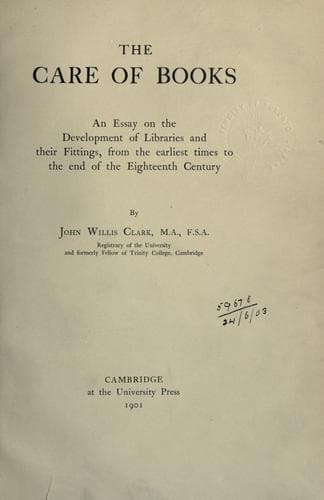
Libraries -- History; Library architecture -- History; Library fittings and supplies -- History
It must not be supposed that an extensive collection of books was regarded
as indispensable in all monastic establishments. In many Houses, partly
from lack of funds, partly from an indisposition to study, the books were
probably limited to those required for the services and for the daily life
of the brethren. In other places, on the contrary, where the fashion of
book-collecting had been set from very early days, by some abbat or prior
more learned or more active than his fellows; and where brethren in
consequence had learnt to take a pride in their books, whether they read
them or not, a large collection was got together at a date when even a
royal library could be contained in a single chest of very modest
dimensions. For instance, when an inventory of the possessions of the
Benedictine House of S. Riquier near Abbeville was made at the request of
Louis le Debonnaire in 831 A.D., it was found that the library contained
250 volumes; and a note at the end of the catalogue informs us that if the
different treatises had been entered separately, the number of entries
would have exceeded five hundred, as many books were frequently bound in a
single volume. The works in this library are roughly sorted under the
headings Divinity, Grammar, History and Geography, Sermons,
Service-books[208]. A similar collection existed at S. Gall at the same
period[209]. In the next century we find nearly seven hundred manuscripts
in a Benedictine monastery at Bobbio in north Italy[210]; and nearly six
hundred in a House belonging to the same order at Lorsch in Germany[211].
At Durham, also a Benedictine House, a catalogue made early in the twelfth
century contains three hundred and sixty-six titles[212]; but, as at S.
Riquier, the number of works probably exceeded six or seven hundred.
These instances, which I have purposely selected from different parts of
Europe, and which could easily have been increased, are sufficient to
indicate the rapidity with which books could be, and in fact were
accumulated, when the taste for such collections had once been set. Year
by year, slowly yet surely, by purchase, by gift, by bequest, by the zeal
of the staff of writers whom the precentor drilled and kept at work, the
number grew, till in certain Houses it reached dimensions which must have
embarrassed those responsible for its bestowal. At Christ Church,
Canterbury, for instance, the catalogue made by Henry de Estria, Prior
1285-1331, enumerates about 1850 manuscripts[213].
Public-domain text, read in full here on John Shaqi.
Reviews
Reviews
No reviews yet
Be the first to share your thoughts on this work.
Elsewhere in the archive
Join the Discussion
Join the discussion
Sign in to leave a comment or review.
Sign InorCreate an account