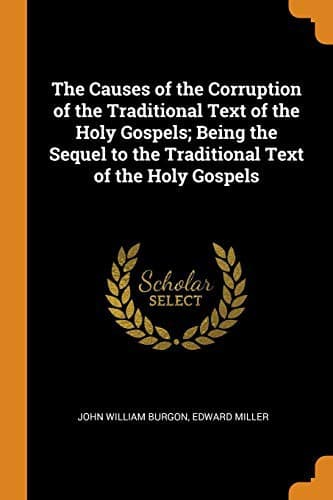
The Causes of the Corruption of the Traditional Text of the Holy Gospels: Being the Sequel to The Traditional Text of the Holy GospelsBurgon, John William
Religion
The Causes of the Corruption of the Traditional Text of the Holy Gospels: Being the Sequel to The Traditional Text of the Holy Gospels
Burgon, John William
Bible. Gospels -- Criticism, Textual
[210] Traditional Text, Appendix IV.
[211] Pesh. and Harkl.: Cur. and Lew. are defective.
[212] Thus Griesbach, Scholz, Lachmann, Tischendorf, Tregelles, Alford,
Wordsworth, Green, Scrivener, M^{c}Clellan, Westcott and Hort, and the
Revisers.
[213] In pseudo-Jerome's Brev. in Psalm., Opp. vii. (ad calc.) 198.
[214] Mont. i. 462.
[215] Ubi supra.
[216] Omitting trifling variants.
[217] [Symbol: Aleph]BL are _exclusively_ responsible on 45 occasions:
+C (i.e. [Symbol: Aleph]BCL), on 27: +D, on 35: +[Symbol: Delta], on 73:
+CD, on 19: +C[Symbol: Delta], on 118: +D[Symbol: Delta] (i.e. [Symbol:
Aleph]BDL[Symbol: Delta]), on 42: +CD[Symbol: Delta], on 66.
[218] In the text of Evan. 72 the reading in dispute is _not_ found:
205, 206 are duplicates of 209: and 222, 255 are only fragments. There
remain 1, 22, 33, 61, 63, 115, 131, 151, 152, 161, 184, 209, 253, 372,
391:--of which the six at Rome require to be re-examined.
[219] v. 10.
[220] _Ap._ Hieron. vii. 17.
[221] 'Evangelistas arguere falsitatis, hoc impiorum est, Celsi,
Porphyrii, Juliani.' Hieron. i. 311.
[222] [Greek: grapheos toinun esti sphalma]. Quoted (from the lost work
of Eusebius ad Marinum) in Victor of Ant.'s Catena, ed. Cramer, p. 267.
(See Simon, iii. 89; Mai, iv. 299; Matthaei's N.T. ii. 20, &c.)
[223] 'Nos autem nomen Isaiae putamus _additum Scriptorum vitio_, quod
et in aliis locis probare possumus.' vii. 17 (I suspect he got it from
Eusebius).
[224] See Studia Biblica, ii. p. 249. Syrian Form of Ammonian sections
and Eusebian Canons by Rev. G. H. Gwilliam, B.D. Mr. Gwilliam gives St.
Luke iii. 4-6, according to the Syrian form.
[225] Compare St. Mark vi. 7-13 with St. Luke ix. 1-6.
[226] Schulz,--'et [Greek: lalia] et [Greek: omoiazei] aliena a Marco.'
Tischendorf--'omnino e Matthaeo fluxit: ipsum [Greek: omoiazei]
glossatoris est.' This is foolishness,--not criticism.
[227] Scrivener's Full Collation of the Cod. Sin., &c., 2nd ed., p.
xlvii.
CHAPTER IX.
CAUSES OF CORRUPTION CHIEFLY INTENTIONAL.
III. Attraction.
Sec. 1.
There exist not a few corrupt Readings,--and they have imposed largely
on many critics,--which, strange to relate, have arisen from nothing
else but the proneness of words standing side by side in a sentence to
be attracted into a likeness of ending,--whether in respect of
grammatical form or of sound; whereby sometimes the sense is made to
suffer grievously,--sometimes entirely to disappear. Let this be called
the error of Attraction. The phenomena of 'Assimilation' are entirely
distinct. A somewhat gross instance, which however has imposed on
learned critics, is furnished by the Revised Text and Version of St.
John vi. 71 and xiii. 26.
Public-domain text, read in full here on John Shaqi.
Reviews
Reviews
No reviews yet
Be the first to share your thoughts on this work.
Elsewhere in the archive
Join the Discussion
Join the discussion
Sign in to leave a comment or review.
Sign InorCreate an account