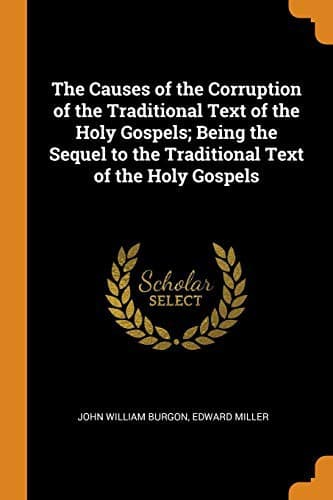
The Causes of the Corruption of the Traditional Text of the Holy Gospels: Being the Sequel to The Traditional Text of the Holy GospelsBurgon, John William
Religion
The Causes of the Corruption of the Traditional Text of the Holy Gospels: Being the Sequel to The Traditional Text of the Holy Gospels
Burgon, John William
Bible. Gospels -- Criticism, Textual
My rejoinder is plain:--Not only am I of course willing to yield to
external evidence, but it is precisely 'external evidence' which makes
me insist on retaining [Greek: deuteroproto--apo melissiou keriou--haras
ton stauron--kai anephereto eis ton ouranon--hotan eklipete]--the 14th
verse of St. Matthew's xxiiird chapter--and the last twelve verses of
St. Mark's Gospel. For my own part, I entirely deny the cogency of the
proposed proof, and I have clearly already established the grounds of my
refusal. Who then is to be the daysman between us? We are driven back on
first principles, in order to ascertain if it may not be possible to
meet on some common ground, and by the application of ordinary logical
principles of reasoning to clear our view. [As to these we must refer
the reader to the first volume of this work. Various cases of omission
have been just quoted, and many have been discussed elsewhere.
Accordingly, it will not be necessary to exhibit this large class of
corruptions at the length which it would otherwise demand. But a few
more instances are required, in order that the reader may see in this
connexion that many passages at least which the opposing school
designate as Interpolations are really genuine, and that students may be
placed upon their guard against the source of error that we are
discussing.]
Sec. 4.
And first as to the rejection of an entire verse.
The 44th verse of St. Matt. xxi, consisting of the fifteen words printed
at foot[265], is marked as doubtful by Tregelles, Westcott and Hort, and
the Revisers:--by Tischendorf it is rejected as spurious. We insist
that, on the contrary, it is indubitably genuine; reasoning from the
antiquity, the variety, the respectability, the largeness, or rather,
the general unanimity of its attestation.
For the verse is found in the Old Latin, and in the Vulgate,--in the
Peshitto, Curetonian, and Harkleian Syriac,--besides in the Coptic,
Armenian, and Ethiopic versions. It is found also in Origen[266],--
ps.-Tatian[267]--Aphraates[268],--Chrysostom[269],--Cyril Alex.[270],--
the Opus Imperfectum[271],--Jerome[272],--Augustine[273]:--in Codexes
B[Symbol: Aleph]C[Symbol: Theta][Symbol: Sigma]XZ[Symbol: Delta][Symbol:
Pi]EFG HKLMSUV,--in short, it is attested by every known Codex except
two of bad character, viz.--D, 33; together with five copies of the Old
Latin, viz.--a b e ff^{1} ff^{2}. There have therefore been adduced for
the verse in dispute at least five witnesses of the second or third
century:--at least eight of the fourth:--at least seven if not eight of
the fifth: after which date the testimony in favour of this verse is
overwhelming. How could we be justified in opposing to such a mass of
first-rate testimony the solitary evidence of Cod. D (concerning which
see above, Vol. I. c. viii.) supported only by a single errant Cursive
and a little handful of copies of the Old Latin versions, [even although
the Lewis Codex has joined this petty band?]
Public-domain text, read in full here on John Shaqi.
Reviews
Reviews
No reviews yet
Be the first to share your thoughts on this work.
Elsewhere in the archive
Join the Discussion
Join the discussion
Sign in to leave a comment or review.
Sign InorCreate an account