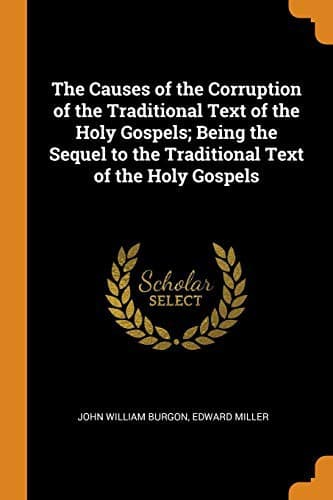
The Causes of the Corruption of the Traditional Text of the Holy Gospels: Being the Sequel to The Traditional Text of the Holy GospelsBurgon, John William
Religion
The Causes of the Corruption of the Traditional Text of the Holy Gospels: Being the Sequel to The Traditional Text of the Holy Gospels
Burgon, John William
Bible. Gospels -- Criticism, Textual
The reader is now in a position to judge how much attention is due to
Dr. Tregelles' dictum 'that this one passage may be relied upon' in
support of the peculiar views he advocates: as well as to his confident
claim that the fuller text which is found in ninety-nine MSS. out of a
hundred 'must be regarded as an amplification borrowed from the
prophet.' It has been shewn in answer to the learned critic that in the
ancient Greek text of the prophet the 'amplification' he speaks of did
not exist: it was the abbreviated text which was found there. So that
the very converse of the phenomenon he supposes has taken place. Freely
accepting his hypothesis that we have here a process of assimilation,
occasioned by the Septuagintal text of Isaiah, we differ from him only
as to the direction in which that process has manifested itself. He
assumes that the bulk of the MSS. have been conformed to the generally
received reading of Isaiah xxix. 13. But it has been shewn that, on the
contrary, it is the two oldest MSS. which have experienced assimilation.
Their prototypes were depraved in this way at an exceedingly remote
period.
To state this matter somewhat differently.--In all the extant uncials
but five, and in almost every known cursive copy of the Gospels, the
words [Greek: to stomati auton, kai] are found to belong to St. Matt.
xv. 8. How is the presence of those words to be accounted for? The reply
is obvious:--By the fact that they must have existed in the original
autograph of the Evangelist. Such however is not the reply of Griesbach
and his followers. They insist that beyond all doubt those words must
have been imported into the Gospel from Isaiah xxix. But I have shewn
that this is impossible; because, at the time spoken of, the words in
question had no place in the Greek text of the prophet. And this
discovery exactly reverses the problem, and brings out the directly
opposite result. For now we discover that we have rather to inquire how
is the absence of the words in question from those few MSS. out of the
mass to be accounted for? The two oldest Codexes are convicted of
exhibiting a text which has been corrupted by the influence of the
oldest Septuagint reading of Isaiah xxix. 13.
I freely admit that it is in a high degree remarkable that five ancient
Versions, and all the following early writers,--Ptolemaeus[295], Clemens
Alexandrinus[296], Origen[297], Didymus[298], Cyril[299], Chrysostom[300],
and possibly three others of like antiquity[301],--should all quote St.
Matthew in this place from a faulty text. But this does but prove at how
extremely remote a period the corruption must have begun. It probably
dates from the first century. Especially does it seem to shew how
distrustful we should be of our oldest authorities when, as here, they
are plainly at variance with the whole torrent of manuscript authority.
This is indeed no ordinary case. There are elements of distrust here,
such as are not commonly encountered.
Sec. 6.
Public-domain text, read in full here on John Shaqi.
Reviews
Reviews
No reviews yet
Be the first to share your thoughts on this work.
Elsewhere in the archive
Join the Discussion
Join the discussion
Sign in to leave a comment or review.
Sign InorCreate an account