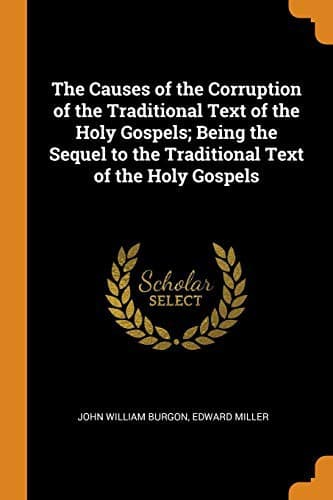
The Causes of the Corruption of the Traditional Text of the Holy Gospels: Being the Sequel to The Traditional Text of the Holy GospelsBurgon, John William
Religion
The Causes of the Corruption of the Traditional Text of the Holy Gospels: Being the Sequel to The Traditional Text of the Holy Gospels
Burgon, John William
Bible. Gospels -- Criticism, Textual
[This characteristic of the old uncials is now commended to the
attention of students, who will find in the folios of those documents
plenty of instances for examination. Most of the cases of Transposition
are petty enough, whilst some, as the specimens already presented to the
reader indicate, constitute blots not favourable to the general
reputation of the copies on which they are found. Indeed, they are so
frequent that they have grown to be a very habit, and must have
propagated themselves. For it is in this secondary character rather than
in any first intention, so to speak, that Transpositions, together with
Omissions and Substitutions and Additions, have become to some extent
independent causes of corruption. Originally produced by other forces,
they have acquired a power of extension in themselves.
It is hoped that the passages already quoted may be found sufficient to
exhibit the character of the large class of instances in which the pure
Text of the original Autographs has been corrupted by Transposition.
That it has been so corrupted, is proved by the evidence which is
generally overpowering in each case. There has clearly been much
intentional perversion: carelessness also and ignorance of Greek
combined with inveterate inaccuracy, characteristics especially of
Western corruption as may be seen in Codex D and the Old Latin versions,
must have had their due share in the evil work. The result has been
found in constant slurs upon the sacred pages, lessening the beauty and
often perverting the sense,--a source of sorrow to the keen scholar and
reverent Christian, and reiterated indignity done in wantonness or
heedlessness to the pure and easy flow of the Holy Books.]
Sec. 4.
[All the Corruption in the Sacred Text may be classed under four heads,
viz. Omission, Transposition, Substitution, and Addition. We are
entirely aware that, in the arrangement adopted in this Volume for
purposes of convenience, Scientific Method has been neglected. The
inevitable result must be that passages are capable of being classed
under more heads than one. But Logical exactness is of less practical
value than a complete and suitable treatment of the corrupted passages
that actually occur in the four Gospels.
It seems therefore needless to supply with a scrupulousness that might
bore our readers a disquisition upon Substitution which has not forced
itself into a place amongst Dean Burgon's papers, although it is found
in a fragmentary plan of this part of the treatise. Substituted forms or
words or phrases, such as [Greek: OS] ([Greek: hos]) for [Greek: THS]
([Greek: Theos])[346] [Greek: eporei] for [Greek: epoiei] (St. Mark vi.
20), or [Greek: ouk oidate dokimazein] for [Greek: dokimazete] (St. Luke
xii. 56), have their own special causes of substitution, and are
naturally and best considered under the cause which in each case gave
them birth.
Public-domain text, read in full here on John Shaqi.
Reviews
Reviews
No reviews yet
Be the first to share your thoughts on this work.
Elsewhere in the archive
Join the Discussion
Join the discussion
Sign in to leave a comment or review.
Sign InorCreate an account