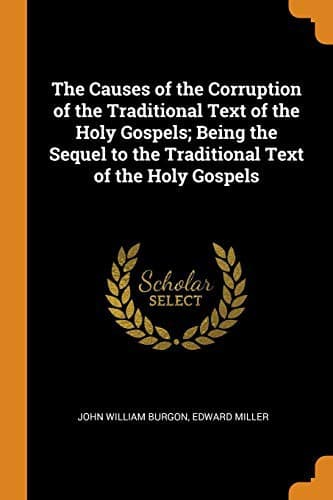
The Causes of the Corruption of the Traditional Text of the Holy Gospels: Being the Sequel to The Traditional Text of the Holy GospelsBurgon, John William
Religion
The Causes of the Corruption of the Traditional Text of the Holy Gospels: Being the Sequel to The Traditional Text of the Holy Gospels
Burgon, John William
Bible. Gospels -- Criticism, Textual
On the whole I have _no doubt_ (though it is not susceptible of _proof_)
that the Peshitto had, in both the places quoted above, [Greek:
phrason].
[361] In St. Mark vii. 3, the translators of the Peshitto render
whatever Greek they had before them by [Syriac letters], which means
'eagerly,' 'sedulously'; cf. use of the word for [Greek: spoudaios], St.
Luke vii. 4; [Greek: epimelos], St Luke xv. 8.
The Root means 'to cease'; thence 'to have leisure for a thing': it has
nothing to do with 'Fist.' [Rev. G.H. Gwilliam.]
[362] Harkl. Marg. _in loc._, and Adler, p. 115.
[363] Viz. a b c e ff^{2} l q.
[364] [Greek: 'Opheilei psyche, en to logo tou Kyriou katakolouthousa,
ton stauron autou kath' hemeran airein, hos gegraptai; tout' estin,
hetoimos echousa hypomenein dia Christon pasan thlipsin kai peirasmon,
k.t.l.] (ii. 326 e). In the same spirit, further on, he exhorts to
constancy and patience,--[Greek: ton epi tou Kyriou thanaton en
epithymiai pantote pro ophthalmon echontes, kai (kathos eiretai hypo tou
Kyriou) kath' hemeran ton stauron airontes, ho esti thanatos] (ii. 332
e). It is fair to assume that Ephraem's reference is to St. Luke ix. 23,
seeing that he wrote not in Greek but in Syriac, and that in the
Peshitto the clause is found only in that place.
[365] [Greek: Akoue Louka legontos],--i. 281 f. Also, int. iii. 543.
[366] Pp. 221 (text), 222, 227.
[367] ii. 751 e, 774 e (in Es.)--the proof that these quotations are
from St. Luke; that Cyril exhibits [Greek: arnesastho] instead of
[Greek: aparn]. (see Tischendorf's note on St. Luke ix. 23). The
quotation in i. 40 (Glaph.) _may_ be from St. Matt. xvi. 24.
[368] Migne, vol. lxxxvi. pp. 256 and 257.
[369] After quoting St. Mark viii. 34,--'aut juxta Lucam, _dicebat ad
cunctos: Si quis vult post me venire, abneget semetipsum; et tollat
crucem suam, et sequetur me_.'--i. 852 c.
This is found in his solution of _XI Quaestiones_, 'ad Algasiam,'--free
translations probably from the Greek of some earlier Father. Six lines
lower down (after quoting words found nowhere in the Gospels), Jerome
proceeds:--'_Quotidie_ credens in Christum _tollit crucem suam_, et
negat seipsum.'
[370] This spurious clause adorned the lost archetype of Evann. 13, 69,
124, 346 (Ferrar's four); and survives in certain other Evangelia which
enjoy a similar repute,--as 1, 33, 72 (with a marginal note of
distrust), 131.
[371] They are St. Matt. xvi. 24; St. Mark viii. 34.
[372] i. 597 c (Adorat.)--elsewhere (viz. i. 21 d; 528 c; 580 b; iv.
1058 a; v^(2). 83 c) Cyril quotes the place correctly. Note, that the
quotation found in Mai, iii. 126, which Pusey edits (v. 418), in Ep. ad
Hebr., is nothing else but an excerpt from the treatise de Adorat. i.
528 c.
Public-domain text, read in full here on John Shaqi.
Reviews
Reviews
No reviews yet
Be the first to share your thoughts on this work.
Elsewhere in the archive
Join the Discussion
Join the discussion
Sign in to leave a comment or review.
Sign InorCreate an account