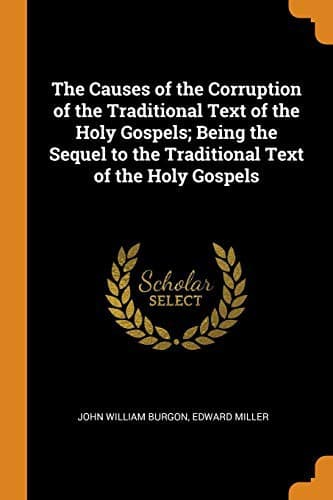
The Causes of the Corruption of the Traditional Text of the Holy Gospels: Being the Sequel to The Traditional Text of the Holy GospelsBurgon, John William
Religion
The Causes of the Corruption of the Traditional Text of the Holy Gospels: Being the Sequel to The Traditional Text of the Holy Gospels
Burgon, John William
Bible. Gospels -- Criticism, Textual
Concerning Marcion, who is a far more conspicuous personage, it will be
necessary to speak more particularly. He has left a mark on the text of
Scripture of which traces are distinctly recognizable at the present
day[457]. A great deal more is known about him than about any other
individual of his school. Justin Martyr and Irenaeus wrote against him:
besides Origen and Clement of Alexandria, Tertullian in the West[458],
and Epiphanius in the East, elaborately refuted his teaching, and give
us large information as to his method of handling Scripture.
Another writer of this remote time who, as I am prone to think, must
have exercised sensible influence on the text of Scripture was Ammonius
of Alexandria.
But Tatian beyond every other early writer of antiquity [appears to me
to have caused alterations in the Sacred Text.]
It is obviously no answer to anything that has gone before to insist
that the Evangelium of Marcion (for instance), so far as it is
recognizable by the notices of it given by Epiphanius, can very rarely
indeed be shewn to have resembled any extant MS. of the Gospels. Let it
be even freely granted that many of the charges brought against it by
Epiphanius with so much warmth, collapse when closely examined and
severely sifted. It is to be remembered that Marcion's Gospel was known
to be an heretical production: one of the many creations of the Gnostic
age,--it must have been universally execrated and abhorred by faithful
men. Besides this lacerated text of St. Luke's Gospel, there was an
Ebionite recension of St. Matthew: a Cerinthian exhibition of St. Mark:
a Valentinian perversion of St. John. And we are but insisting that the
effect of so many corruptions of the Truth, industriously propagated
within far less than 100 years of the date of the inspired verities
themselves, must needs have made itself sensibly felt. Add the notorious
fact, that in the second and third centuries after the Christian era the
text of the Gospels is found to have been grossly corrupted even in
orthodox quarters,--and that traces of these gross corruptions are
discoverable in certain circles to the present hour,--and it seems
impossible not to connect the two phenomena together. The wonder rather
is that, at the end of so many centuries, we are able distinctly to
recognize any evidence whatever.
The proneness of these early Heretics severally to adopt one of the four
Gospels for their own, explains why there is no consistency observable
in the corruptions they introduced into the text. It also explains the
bringing into one Gospel of things which of right clearly belong to
another--as in St. Mark iii. 14 [Greek: ous kai apostolous onomasen].
Public-domain text, read in full here on John Shaqi.
Reviews
Reviews
No reviews yet
Be the first to share your thoughts on this work.
Elsewhere in the archive
Join the Discussion
Join the discussion
Sign in to leave a comment or review.
Sign InorCreate an account