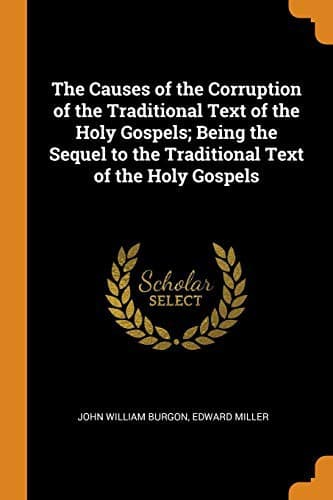
The Causes of the Corruption of the Traditional Text of the Holy Gospels: Being the Sequel to The Traditional Text of the Holy GospelsBurgon, John William
Religion
The Causes of the Corruption of the Traditional Text of the Holy Gospels: Being the Sequel to The Traditional Text of the Holy Gospels
Burgon, John William
Bible. Gospels -- Criticism, Textual
But now, let me ask,--Will any one be disposed, after a careful survey
of the premisses, to accept the verdict of Tischendorf, Tregelles and
the rest, who are for bringing the Church back to the maimed text of
which I began by giving the history and explaining the origin? Let it be
noted that the one question is,--shall [Greek: ho Kyrios] be retained in
the second clause, or not? But there it stood within thirty years of the
death of St. John: and there it stands, at the end of eighteen centuries
in every extant copy (including AKLP) except nine. It has been
excellently witnessed to all down the ages,--viz. By Origen, Hippolytus,
Athanasius, Basil, Chrysostom, Cyril, Theodotus, Eutherius, Theodore
Mops., Damascene and others. On what principle would you now reject
it?... With critics who assume that a reading found in [Symbol:
Aleph]BCDEFG must needs be genuine,--it is vain to argue. And yet the
most robust faith ought to be effectually shaken by the discovery that
four, if not five ([Symbol: Aleph]ACFG) of these same MSS., by reading
'we shall all sleep; but we shall not all be changed,' contradict St.
Paul's solemn announcement in ver. 51: while a sixth (D) stands alone in
substituting 'we shall all rise; but we shall not all be changed.'--In
this very verse, C is for introducing [Greek: Adam] into the first
clause of the sentence: FG, for subjoining [Greek: ho ouranios]. When
will men believe that guides like these are to be entertained with
habitual distrust? to be listened to with the greatest caution? to be
followed, for their own sakes,--never?
I have been the fuller on this place, because it affords an instructive
example of what has occasionally befallen the words of Scripture. Very
seldom indeed are we able to handle a text in this way. Only when the
heretics assailed, did the orthodox defend: whereby it came to pass that
a record was preserved of how the text was read by the ancient Father.
The attentive reader will note (_a_) That all the changes which we have
been considering belong to the earliest age of all:--(_b_) That the
corrupt reading is retained by [Symbol: Aleph]BC and their following:
the genuine text, in the great bulk of the copies:--(_c_) That the first
mention of the text is found in the writings of an early heretic:--(_d_)
That [the orthodox introduced a change in the interests, as they
fancied, of truth, but from utter misapprehension of the nature and
authority of the Word of God:--and (_e_) that under the Divine
Providence that change was so effectually thrown out, that decisive
witness is found on the other side].
Sec. 4.
Public-domain text, read in full here on John Shaqi.
Reviews
Reviews
No reviews yet
Be the first to share your thoughts on this work.
Elsewhere in the archive
Join the Discussion
Join the discussion
Sign in to leave a comment or review.
Sign InorCreate an account