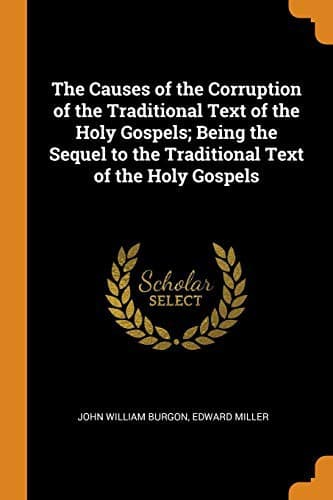
The Causes of the Corruption of the Traditional Text of the Holy Gospels: Being the Sequel to The Traditional Text of the Holy GospelsBurgon, John William
Religion
The Causes of the Corruption of the Traditional Text of the Holy Gospels: Being the Sequel to The Traditional Text of the Holy Gospels
Burgon, John William
Bible. Gospels -- Criticism, Textual
And yet, the entire aspect of the case becomes changed the instant it is
perceived that this disputed clause is recognized by Clemens[565] (A.D.
190); as well as by the Old Latin, by the Peshitto, and by the
Curetonian Syriac: for the fact is thus established that as well in
Eastern as in Western Christendom the words under discussion were
actually recognized as genuine full a hundred and fifty years before the
oldest of the extant uncials came into existence. When it is further
found that (besides Ambrose, Jerome, Augustine,) the Vulgate, the Old
Egyptian, the Harkleian Syriac and the Gothic versions also contain the
words in question; and especially that Chrysostom in four places,
Didymus, Epiphanius, Cyril and Theodoret, besides Antiochus, familiarly
quote them, it is evident that the testimony of antiquity in their
favour is even overwhelming. Add that in eight uncial MSS. (beginning
with D) the words in dispute form part of the text of St. Luke, and that
they are recognized by the great mass of the cursive copies,--(only six
out of the twenty which Scrivener has collated being without them,)--and
it is plain that at least five tests of genuineness have been fully
satisfied.
(2) The third clause ([Greek: ho gar huios tou anthropou ouk elthe
psychas anthropon apolesai, alla sosai]) rests on precisely the same
solid evidence as the second; except that the testimony of Clemens is no
longer available,--but only because his quotation does not extend so
far. Cod. D also omits this third clause; which on the other hand is
upheld by Tertullian, Cyprian and Ambrose. Tischendorf suggests that it
has surreptitiously found its way into the text from St. Luke xix. 10,
or St. Matt, xviii. 11. But this is impossible; simply because what is
found in those two places is essentially different: namely,--[Greek:
elthe gar ho huios tou anthropou zetesai kai][566] [Greek: sosai to
apololos].
(3) We are at liberty in the meantime to note how apt an illustration is
here afforded of the amount of consensus which subsists between
documents of the oldest class. This divergence becomes most conspicuous
when we direct our attention to the grounds for omitting the foremost
clause of the three, [Greek: hos kai Elias epoiesen]: for here we make
the notable discovery that the evidence is not only less weighty, but
also different. Codexes B and [Symbol: Aleph] are now forsaken by all
their former allies except L[Symbol: Xi] and a single cursive copy.
True, they are supported by the Curetonian Syriac, the Vulgate and two
copies of the Old Latin. But this time they find themselves confronted
by Codexes ACD with thirteen other uncials and the whole body of the
cursives; the Peshitto, Coptic, Gothic, and Harkleian versions; by
Clemens, Jerome, Chrysostom, Cyril and pseudo-Basil. In respect of
antiquity, variety, respectability, numbers, they are therefore
hopelessly outvoted.
Public-domain text, read in full here on John Shaqi.
Reviews
Reviews
No reviews yet
Be the first to share your thoughts on this work.
Elsewhere in the archive
Join the Discussion
Join the discussion
Sign in to leave a comment or review.
Sign InorCreate an account