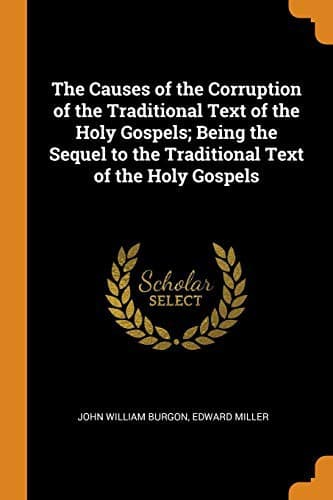
The Causes of the Corruption of the Traditional Text of the Holy Gospels: Being the Sequel to The Traditional Text of the Holy GospelsBurgon, John William
Religion
The Causes of the Corruption of the Traditional Text of the Holy Gospels: Being the Sequel to The Traditional Text of the Holy Gospels
Burgon, John William
Bible. Gospels -- Criticism, Textual
Above all,--(the reader is entreated to give the subject his sustained
attention),--Is it not perceived that the admission involved in the
hypothesis before us is fatal to any rational pretence that the passage
is of spurious origin? We have got back in thought at least to the third
or fourth century of our era. We are among the Fathers and Doctors of
the Eastern Church in conference assembled: and they are determining
what shall be the Gospel for the great Festival of Pentecost. 'It shall
begin' (say they) 'at the thirty-seventh verse of St. John vii, and
conclude with the twelfth verse of St. John viii. But so much of it as
relates to the breaking up of the Sanhedrin,--to the withdrawal of our
Lord to the Mount of Olives,--and to His return next morning to the
Temple,--had better not be read. It disturbs the unity of the narrative.
So also had the incident of the woman taken in adultery better not be
read. It is inappropriate to the Pentecostal Festival.' The Authors of
the great Oriental Liturgy therefore admit that they find the disputed
verses in their copies: and thus they vouch for their genuineness. For
none will doubt that, had they regarded them as a spurious accretion to
the inspired page, they would have said so plainly. Nor can it be denied
that if in their corporate capacity they had disallowed these twelve
verses, such an authoritative condemnation would most certainly have
resulted in the perpetual exclusion from the Sacred Text of the part of
these verses which was actually adopted as a Lection. What stronger
testimony on the contrary can be imagined to the genuineness of any
given portion of the everlasting Gospel than that it should have been
canonized or recognized as part of Inspired Scripture by the collective
wisdom of the Church in the third or fourth century?
And no one may regard it as a suspicious circumstance that the present
Pentecostal lection has been thus maimed and mutilated in respect of
twelve of its verses. There is nothing at all extraordinary in the
treatment which St. John vii. 37-viii. 12 has here experienced. The
phenomenon is even of perpetual recurrence in the Lectionary of the
East,--as will be found explained below[614].
Public-domain text, read in full here on John Shaqi.
Reviews
Reviews
No reviews yet
Be the first to share your thoughts on this work.
Elsewhere in the archive
Join the Discussion
Join the discussion
Sign in to leave a comment or review.
Sign InorCreate an account