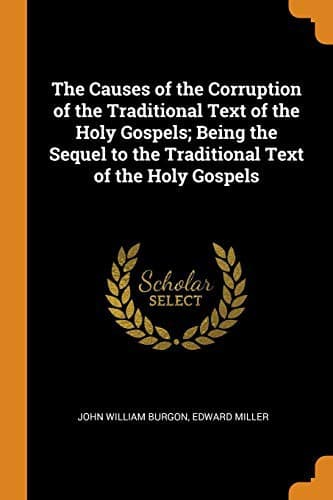
The Causes of the Corruption of the Traditional Text of the Holy Gospels: Being the Sequel to The Traditional Text of the Holy GospelsBurgon, John William
Religion
The Causes of the Corruption of the Traditional Text of the Holy Gospels: Being the Sequel to The Traditional Text of the Holy Gospels
Burgon, John William
Bible. Gospels -- Criticism, Textual
I suspect that if we ever obtain access to a specimen of those connected
Gospel narratives called Diatessarons, which are known to have existed
anciently in the Church, we shall be furnished with a clue to a problem
which at present is shrouded in obscurity,--and concerning the solution
of which, with such instruments of criticism as we at present possess,
we can do little else but conjecture. I allude to those many occasions
on which the oldest documents extant, in narrating some incident which
really presents no special difficulty, are observed to diverge into
hopeless variety of expression. An example of the thing referred to will
best explain my meaning. Take then the incident of our Lord's paying
tribute,--set down in St. Matt. xvii. 25, 26.
The received text exhibits,--'And when he [Peter] had entered ([Greek:
hote eiselthen]) into the house, Jesus was beforehand with him, saying,
What thinkest thou, Simon? Of whom do earthly kings take toll or
tribute? of their sons or of strangers?' Here, for [Greek: hote
eiselthen], Codex B (but no other uncial) substitutes [Greek: elthonta]:
Codex [Symbol: Aleph] (but no other) [Greek: eiselthonta]: Codex D (but
no other) [Greek: eiselthonti]: Codex C (but no other) [Greek: hote
elthon]: while a fifth lost copy certainly contained [Greek:
eiselthonton]; and a sixth, [Greek: elthonton auton]. A very fair
specimen this, be it remarked in passing, of the _concordia discors_
which prevails in the most ancient uncial copies[179]. How is all this
discrepancy to be accounted for?
The Evangelist proceeds,--'Peter saith unto Him ([Greek: Legei auto ho
Petros]), Of strangers.' These four words C retains, but continues--'Now
when he had said, Of strangers' ([Greek: Eipontos de autou, apo ton
allotrion]);--which unauthorized clause, all but the word [Greek:
autou], is found also in [Symbol: Aleph], but in no other uncial. On the
other hand, for [Greek: Legei auto ho Petros], [Symbol: Aleph] (alone of
uncials) substitutes [Greek: Ho de ephe]: and B (also alone of uncials)
substitutes [Greek: Eipontos de],--and then proceeds exactly like the
received text: while D merely omits [Greek: ho Petros]. Again I
ask,--How is all this discrepancy to be explained[180]?
Public-domain text, read in full here on John Shaqi.
Reviews
Reviews
No reviews yet
Be the first to share your thoughts on this work.
Elsewhere in the archive
Join the Discussion
Join the discussion
Sign in to leave a comment or review.
Sign InorCreate an account