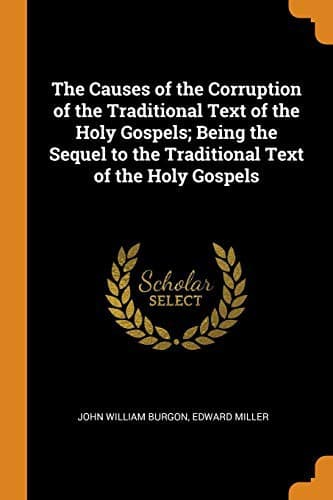
The Causes of the Corruption of the Traditional Text of the Holy Gospels: Being the Sequel to The Traditional Text of the Holy GospelsBurgon, John William
Religion
The Causes of the Corruption of the Traditional Text of the Holy Gospels: Being the Sequel to The Traditional Text of the Holy Gospels
Burgon, John William
Bible. Gospels -- Criticism, Textual
Not that we would imply that permanent mischief has resulted to the
Deposit from the vagaries of individuals in the earliest age. The Divine
Author of Scripture hath abundantly provided for the safety of His Word
written. In the multitude of copies,--in Lectionaries,--in Versions,--in
citations by the Fathers, a sufficient safeguard against error hath been
erected. But then, of these multitudinous sources of protection we must
not be slow to avail ourselves impartially. The prejudice which would
erect Codexes B and [Symbol: Aleph] into an authority for the text of
the New Testament from which there shall be no appeal:--the
superstitious reverence which has grown up for one little cluster of
authorities, to the disparagement of all other evidence wheresoever
found; this, which is for ever landing critics in results which are
simply irrational and untenable, must be unconditionally abandoned, if
any real progress is to be made in this department of inquiry. But when
this has been done, men will begin to open their eyes to the fact that
the little handful of documents recently so much in favour, are, on the
contrary, the only surviving witnesses to corruptions of the Text which
the Church in her corporate capacity has long since deliberately
rejected. But to proceed.
[From the Diatessaron of Tatian and similar attempts to harmonize the
Gospels, corruption of a serious nature has ensued in some well-known
places, such as the transference of the piercing of the Lord's side from
St. John xix. 34 to St. Matt. xxvii. 49[181], and the omission of the
words 'and of an honeycomb' ([Greek: kai apo tou melissiou
keriou][182]).]
Hence also, in Cureton's Syriac[183], the _patch-work_ supplement to St.
Matt. xxi. 9: viz.:--[Greek: polloi de] (St. Mark xi. 8) [Greek:
exelthon eis hypantesin autou. kai] (St. John xii. 13) [Greek: erxanto
... chairontes ainein ton Theon ... peri pason hon eidon] (St. Luke xix.
37). This self-evident fabrication, 'if it be not a part of the original
Aramaic of St. Matthew,' remarks Dr. Cureton, 'would appear to have been
supplied from the parallel passages of Luke and John conjointly.' How is
it that even a sense of humour did not preserve that eminent scholar
from hazarding the conjecture, that such a self-evident deflection of
his corrupt Syriac Codex from the course all but universally pursued is
a recovery of one more genuine utterance of the Holy Ghost?
FOOTNOTES:
[173] [Greek: Maria de heistekei pros to mnemeion klaiousa exo] (St.
John xx. 11). Comp. the expression [Greek: pros to phos] in St. Luke
xxii. 56. Note, that the above is not offered as a revised translation;
but only to shew unlearned readers what the words of the original
exactly mean.
[174] Note, that in the sectional system of Eusebius _according to the
Greek_, the following places are brought together:--
Public-domain text, read in full here on John Shaqi.
Reviews
Reviews
No reviews yet
Be the first to share your thoughts on this work.
Elsewhere in the archive
Join the Discussion
Join the discussion
Sign in to leave a comment or review.
Sign InorCreate an account