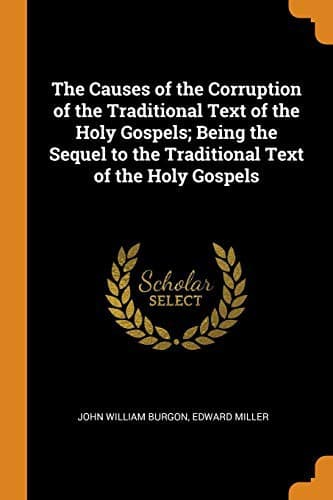
The Causes of the Corruption of the Traditional Text of the Holy Gospels: Being the Sequel to The Traditional Text of the Holy GospelsBurgon, John William
Religion
The Causes of the Corruption of the Traditional Text of the Holy Gospels: Being the Sequel to The Traditional Text of the Holy Gospels
Burgon, John William
Bible. Gospels -- Criticism, Textual
The value--may I not say, the use?--of these delicate differences of
detail becomes apparent whenever the genuineness of the text is called
in question. Take an example. The following fifteen words are
deliberately excluded from St. Mark's Gospel (vi. 11) by some critics on
the authority of [Symbol: Aleph]BCDL[Symbol: Delta],--a most suspicious
company, and three cursives; besides a few copies of the Old Latin,
including the Vulgate:--[Greek: amen lego hymin, anektoteron estai
Sodomois e Gomorrois en hemerai kriseos, he te polei ekeine]. It is
pretended that this is nothing else but an importation from the parallel
place of St. Matthew's Gospel (x. 15). But that is impossible: for, as
the reader sees at a glance, a delicate but decisive note of
discrimination has been set on the two places. St. Mark writes, [Greek:
SodomOIS E GomorrOIS]: St. Matthew, [Greek: GE SodomON KAI GomorrON].
And this threefold, or rather fourfold, diversity of expression has
existed from the beginning; for it has been faithfully retained all down
the ages: it exists to this hour in every known copy of the Gospel,--
except of course those nine which omit the sentence altogether. There
can be therefore no doubt about its genuineness. The critics of the
modern school (Lachmann, Tischendorf, Tregelles, Alford, Westcott and
Hort) seek in vain to put upon us a mutilated text by omitting those
fifteen words. The two places are clearly independent of each other.
It does but remain to point out that the exclusion of these fifteen
words from the text of St. Mark, has merely resulted from the influence
of the parallel place in St. Luke's Gospel (ix. 5),--where nothing
whatever is found[225] corresponding with St. Matt. x. 5--St. Mark vi.
11. The process of Assimilation therefore has been actively at work
here, although not in the way which some critics suppose. It has
resulted, not in the insertion of the words in dispute in the case of
the very many copies; but on the contrary in their omission from the
very few. And thus, one more brand is set on [Symbol: Aleph]BCDL[Symbol:
Delta] and their Latin allies,--which will be found _never_ to conspire
together exclusively except to mislead.
Sec. 7.
Because a certain clause (e.g. [Greek: kai he lalia sou homoiazei] in
St. Mark xiv. 70) is absent from Codd. [Symbol: Aleph]BCDL, Lachmann,
Tischendorf, Tregelles, Alford, Westcott and Hort entirely eject these
five precious words from St. Mark's Gospel, Griesbach having already
voted them 'probably spurious.' When it has been added that many copies
of the Old Latin also, together with the Vulgate and the Egyptian
versions, besides Eusebius, ignore their existence, the present writer
scarcely expects to be listened to if he insists that the words are
perfectly genuine notwithstanding. The thing is certain however, and the
Revisers are to blame for having surrendered five precious words of
genuine Scripture, as I am going to shew.
Public-domain text, read in full here on John Shaqi.
Reviews
Reviews
No reviews yet
Be the first to share your thoughts on this work.
Elsewhere in the archive
Join the Discussion
Join the discussion
Sign in to leave a comment or review.
Sign InorCreate an account