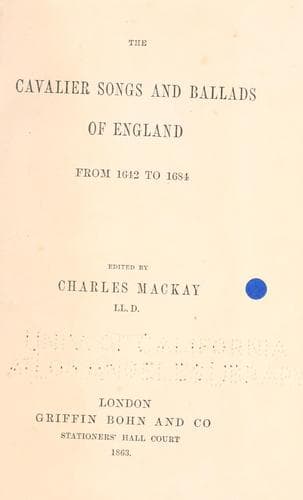
The Cavalier Songs and Ballads of England from 1642 to 1684
History
The Cavalier Songs and Ballads of England from 1642 to 1684
Ballads, English; English poetry -- Early modern, 1500-1700
“The events which gave occasion to the following ballad,” says Mr T.
Wright in his Political Ballads, published for the Percy Society,
“may be summed up in a few words. After the death of Cromwell, his
son Richard was without opposition raised to the Protectorate; but
his weak and easy character gave an opening to the intrigues of the
Royalists, and the factious movement of the Republican party.
Fleetwood, who had been named commander-in-chief of the army under
the Protector, plotted to gain the chief power in the State, and was
joined by Lambert, Desborough, and others. The Republicans were
strengthened by the return of Vane, Ludlow, and Bradshaw, to the
Parliament called by the new Protector. Lambert, the Protector’s
brother-in-law, was the ostensible head of a party, and seems to have
aimed at obtaining the power which had been held by Oliver. They
formed a council of officers, who met at Wallingford House; and on
the 20th April, 1659, having gained the upper hand, and having
obtained the dissolution of the Parliament, they determined to
restore the old Long Parliament, which they said had only been
interrupted, and not legally dissolved, and to set aside the
Protector, who soon afterwards resigned. On the 21st April,
Lenthall, the old Speaker, with as many members of the Long
Parliament as could be brought together, met in the House, and opened
their session. The Parliament thus formed, as being the fag-end of
the old Long Parliament, obtained the name of the Rump Parliament.
Lambert’s hopes and aims were raised by his success against Sir
George Booth in the August following, and jealousies soon arose
between his party in the army and the Rump. The Parliament would
have dismissed him, and the chief officers in the cabal with him, but
Lambert with the army in October hindered their free meeting, and
took the management of the government into the hands of a council of
officers, whom they called the Committee of Safety. Towards the
latter end of the year, the tide began to be changed in favour of the
Parliament, by the declaration of Monk in Scotland, Henry Cromwell
with the army in Ireland, and Hazelrigge and the officers at
Portsmouth, in favour of the freedom of the Parliament. This ballad
was written at the period when Lambert’s party was uppermost.”
The tune of “Hei ho, my honey,” may be found in Playford’s edition of
“The English Dancing Master,” printed in 1686, but in no earlier edition
of the same work.
Public-domain text, read in full here on John Shaqi.
Reviews
Reviews
No reviews yet
Be the first to share your thoughts on this work.
Elsewhere in the archive
Join the Discussion
Join the discussion
Sign in to leave a comment or review.
Sign InorCreate an account