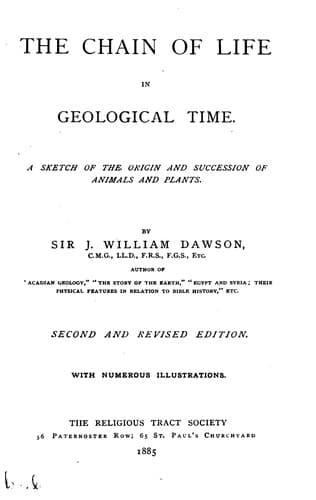
The Chain of Life in Geological Time: A Sketch of the Origin and Succession of Animals and PlantsDawson, John William, Sir
Science
The Chain of Life in Geological Time: A Sketch of the Origin and Succession of Animals and Plants
Dawson, John William, Sir
Paleobotany; Paleontology
Post-Pliocene, showing that the genus existed there up to a
comparatively late period; and when re-introduced it has thriven and run
wild in the more temperate regions. What cause could have led to its
extinction in Post-Glacial times is as yet a mystery. This genealogy of
the horse, independently of its evolutionist application, is very
interesting. It shows that some Eocene types were suited to continuance,
and even adapted for extension, while others were destined to become
altogether extinct at an early date. It shows farther that the power of
continuance resided not so much in the gigantic and prominent species as
in smaller forms. It is to be observed, however, that Gaudry and other
orthodox evolutionists in Europe deduce the horse, not from _Eohippus_,
but from _Palæotherium_, and that it is equally impossible to verify
either phylogeny, since the mere sequence of more or less closely allied
species in time does not prove continuous derivation. Nor indeed are we
certain that one-toed horses like those now living did not exist on the
dry plains in Eocene times, since the inhabitants of these plains are
probably unknown to us. An amusing illustration of the probable reason
of the disappearance of the missing links has recently been given by a
writer not very favourable to the new philosophy. The several
consecutive species may be represented by coins. We may suppose, for
example, sixpences to have been coined first, then sevenpenny and
eightpenny pieces, and so on up to a shilling, then pieces representing
thirteen, fourteen and fifteen pence, and so on up to a half-crown or
crown; but all the intervening denominations between the sixpence and
the shilling, and between the shilling and the half-crown, were found
practically of little use. Hence few were coined, and they soon became
obsolete. Thus the antiquary would find only a few denominations, and
those connecting them would be seldom or never found. It is plain that
if we could suppose that nations constructed their coinage after this
unthinking and empirical fashion, and that if we were justified in
ascribing a similar procedure to the Creator, it might help to account
for the facts as we find them, otherwise we should rather suppose that
in both cases something like plan and calculation determined the
selection of the species produced, whether of coins or animals. But
Chance is a blind goddess, and if we instal her as creator, we must
expect the work to proceed by a series of abortive experiments.
Public-domain text, read in full here on John Shaqi.
Reviews
Reviews
No reviews yet
Be the first to share your thoughts on this work.
Elsewhere in the archive
Join the Discussion
Join the discussion
Sign in to leave a comment or review.
Sign InorCreate an account