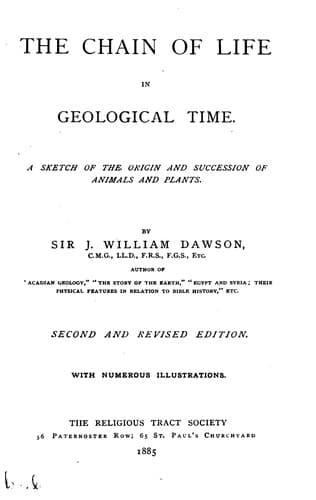
The Chain of Life in Geological Time: A Sketch of the Origin and Succession of Animals and PlantsDawson, John William, Sir
Science
The Chain of Life in Geological Time: A Sketch of the Origin and Succession of Animals and Plants
Dawson, John William, Sir
Paleobotany; Paleontology
| | | Mississippi. |
| | | |
| "Moraines de Fond," | Till, or Older | Boulder Clays, with |
| or Boulder Clay | Boulder Clay. | Local and some |
| proper. | | Travelled Boulders. |
| | | |
| | | Old Land Surfaces--Peat |
| Ancient Diluvial | Pebbly Beds and | under Boulder Clay, |
| Sand. | Weyburne Sands, | Local Gravels and |
| | Lignitic Forest | Sands. |
| | Beds. | |
| | | Pre-glacial Gravels of |
| | | British Columbia. |
+---------------------+--------------------+--------------------------+
In what part of this sequence did man appear? In answer to this, I think
it is now generally admitted that he is not certainly known earlier than
the Post-glacial period. Various supposed indications of his presence in
“Interglacial” Glacial, Pliocene, and even Miocene deposits have proved
on examination to be unreliable. America has recently put forth claims
to have been inhabited by man in the Pliocene, on the faith of remains
found in auriferous gravels in the West. But the facts that the
implements and bones found are modern in type, that the gravels were
deeply mined by the Indians, and that the objects found, as mortars for
dressing gravel, etc., are in many cases such as they would be likely to
leave in their excavations, have discredited these supposed discoveries.
Still more recently, chipped flints found in gravels in New Jersey, by
Abbott, have been supposed to carry back the Indians of the East coast
to the Glacial period. It is evident, however, from the description of
these deposits by the late Mr. Belt and by Professor Cook, director of
the Survey of New Jersey, that they are really Post-glacial, that their
age must be estimated by study of the local conditions, and that there
is no good ground for correlating them with the upper members of the
true Glacial drift to the northwards, with which they had been somewhat
rashly identified. Irrespective of the doubtful character of many if not
all of the so-called implements, the deposits in which they are found is
confessedly not a product of the ice of the Glacial period proper,
whether that was, as some maintain, a period of land glaciation as far
south as New Jersey or not. It belongs to a time of denudation by water,
aided perhaps by floating ice, and is not necessarily older than the
river gravels of the Somme, which, like it, contain boulders and imply
conditions of torrential action and climate which have long since passed
away.
Public-domain text, read in full here on John Shaqi.
Reviews
Reviews
No reviews yet
Be the first to share your thoughts on this work.
Elsewhere in the archive
Join the Discussion
Join the discussion
Sign in to leave a comment or review.
Sign InorCreate an account