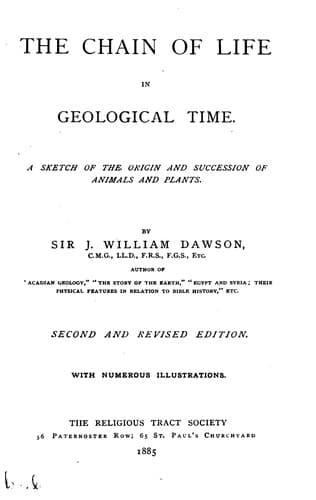
The Chain of Life in Geological Time: A Sketch of the Origin and Succession of Animals and PlantsDawson, John William, Sir
Science
The Chain of Life in Geological Time: A Sketch of the Origin and Succession of Animals and Plants
Dawson, John William, Sir
Paleobotany; Paleontology
If man is so recent geologically, he may still be very old historically;
and the question remains, Have we any facts bearing on the absolute
antiquity of man? For the properly historical aspect of this question,
I may refer to the excellent work of Canon Rawlinson on the _Origin of
Nations_,[89] which shows conclusively that the historic origin of all
the great nations of antiquity extends backward less than 4,400 years
from our time. Beyond this we have, however, the Palæocosmic or
Antediluvian men; and their extension backward seems limited
geologically only by the close of the Glacial period, while many hold
that the Genealogy in Genesis does not require us to limit very narrowly
their antiquity. The date of the Glacial period is, however, at present
very uncertain. On the one hand, some geologists, like Lyell, have
supposed it may be as far back as 200,000 years ago. Others, like Croll,
are contented with the more moderate estimate of 80,000 years. On the
other hand, the calculations of Andrews, based on the recession of the
American lakes, those of Winchell on the recession of the Falls of St.
Anthony, and the recent surveys of the recession of the Falls of
Niagara, reduce the time to from 7,000 to 10,000 years. It is impossible
in the present state of knowledge to settle these disputes; but one may
refer in the sequel to some of the evidences which have been adduced in
favour of great antiquity. Since the publication of the second edition
of this work Prof. Prestwich, in a paper read before the Geological
Society,[90] has brought forward other reasons which induce him to
conclude that the close of the Glacial epoch occurred “from 8,000 to
10,000 years since.” It is true, he admits, on geological evidence still
in dispute, that man may have existed in Europe before that time, and he
also admits, on historical, not geological evidence, the existence of
“Neolithic” man in Asia, “at an earlier date than 4,000 B.C.” Still the
repudiation, by so good an authority, of the exaggerated antiquity which
it has been the fashion, since the rise of Darwinian evolution, to
assign to man, contrary to the geological evidence, is a satisfactory
indication of a return to more rational views; and when geologists get
rid of the fiction of a continental ice-sheet, still farther progress
in this direction may be expected.
Public-domain text, read in full here on John Shaqi.
Reviews
Reviews
No reviews yet
Be the first to share your thoughts on this work.
Elsewhere in the archive
Join the Discussion
Join the discussion
Sign in to leave a comment or review.
Sign InorCreate an account