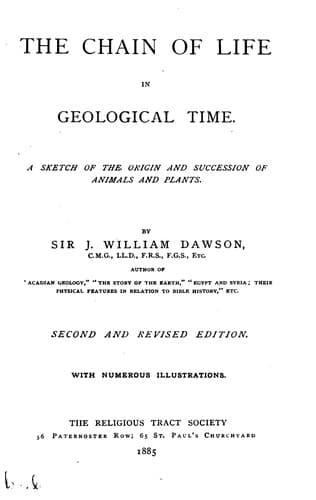
The Chain of Life in Geological Time: A Sketch of the Origin and Succession of Animals and PlantsDawson, John William, Sir
Science
The Chain of Life in Geological Time: A Sketch of the Origin and Succession of Animals and Plants
Dawson, John William, Sir
Paleobotany; Paleontology
Perhaps some of the most remarkable facts in connection with the
permanence of species and varietal forms are those furnished by that
magnificent flora which burst in all its majesty on the American
continent in the Cretaceous period, and still survives among us even in
some of its specific types, I say survives; for we have but a remnant of
its forms living, and comparatively little that is new has probably been
added since. Take, for example, the facts stated in Chapter VIII. as to
the continuance to the present time of species of plants introduced in
the Cretaceous and Eocene, and which thus came in at the very time when
the great Mesozoic reptiles were decaying or had just disappeared, and
when the placental mammals were being introduced. Some of these plants
must have propagated themselves unchanged for half a million of years.
Plants and the lower tribes of animals are, however, more permanent than
the higher animals; and a strange contrast is afforded to the foregoing
examples of persistence by the repeated revolutions that have affected
vertebrate life since the Mesozoic age. Yet even in the case of
vertebrates there seems to have been little change, except in the
extinction of species, since the Pliocene period.
In conclusion of this review, can we formulate a few of the general
laws, or perhaps I had better call them the general conclusions
respecting life, in which all palæontologists may agree? Perhaps it is
not possible to do this at present satisfactorily, but the attempt may
do no harm. We may, then, I think, make the following affirmations:—
(1) The existence of life and organisation on the earth is not eternal,
or even coeval with the beginning of the physical universe, but may
possibly date from Laurentian or immediately pre-Laurentian times.
(2) The introduction of new species of animals and plants has been a
continuous process, not necessarily in the sense of derivation of one
species from another, but in the higher sense of the continued operation
of the cause or causes which introduced life at first. This, as already
stated, I take to be the true theological or Scriptural as well as
scientific idea of what we ordinarily and somewhat loosely term
creation.
(3) Though thus continuous, the process has not been uniform; but
periods of rapid production of species have alternated with others in
which many disappeared and few were introduced. This may have been an
effect of physical cycles reacting on the progress of life.
(4) Species, like individuals, have greater energy and vitality in their
younger stages, and rapidly assume all their varietal forms, and extend
themselves as widely as external circumstances will permit. Like
individuals, also, they have their periods of old age and decay, though
the life of some species has been of enormous duration in comparison
with that of others; the difference appearing to be connected with
degrees of adaptation to different conditions of life.
Public-domain text, read in full here on John Shaqi.
Reviews
Reviews
No reviews yet
Be the first to share your thoughts on this work.
Elsewhere in the archive
Join the Discussion
Join the discussion
Sign in to leave a comment or review.
Sign InorCreate an account