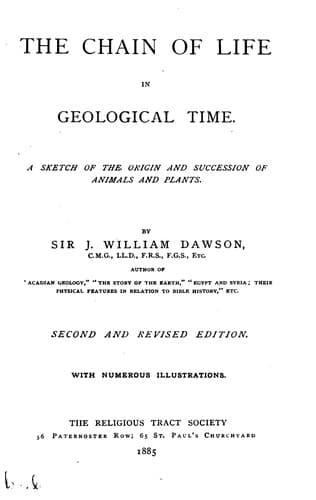
The Chain of Life in Geological Time: A Sketch of the Origin and Succession of Animals and PlantsDawson, John William, Sir
Science
The Chain of Life in Geological Time: A Sketch of the Origin and Succession of Animals and Plants
Dawson, John William, Sir
Paleobotany; Paleontology
The history of fishes extends further through geological time than that
of any other Vertebrates, and is perhaps more completely known to us, in
consequence of the greater facilities for the preservation of their
remains in aqueous deposits. If we receive Pander’s Conodonts as
indicating a low type of cartilaginous fishes, these must have
continued for vast ages without any elevation, and struggling for a bare
existence amidst formidable Cuttle-fishes and Crustaceans, before, under
more favourable conditions, they suddenly expanded into the high and
perfect types of Ganoids and Sharks. If we reject the early Conodonts,
then the two last-mentioned types spring together and suddenly into
existence, like the armed men from the dragon’s teeth of Cadmus. They
rapidly attain to numbers and grandeur unexampled in later times, and
become the lords of the waters at the time when there was probably no
Vertebrate life on the land. As the reptiles establish themselves on the
land and in the waters, the Ganoids diminish, but the Sharks hold their
own. At length the reign of reptiles is over, but the Ganoids, instead
of resuming their pristine numbers, give place to the Teleosts, and
become reduced to insignificance; while the Sharks, profiting by the
decadence of the great marine reptiles, remain the tyrants of the seas.
This history is strangely unlike a continuous evolution; but we are
anticipating facts which will fall to be discussed in a subsequent
chapter.
[Illustration: FIG. 122.—Modern Ganoids (_Polypterus._ Africa.
_Lepidosteus._ America).]
[Illustration: A MICROSAURIAN OF THE CARBONIFEROUS PERIOD (_Hylonomus
Lyelli_). RESTORED FROM THE SKELETON AND DERMAL APPENDAGES FOUND IN AN
ERECT SIGILLARIA. HALF NATURAL SIZE.]
CHAPTER VI.
THE FIRST AIR-BREATHERS.
Were our experience limited to the animals whose remains are found in
the earlier Palæozoic rocks, we might be unable to conceive the
possibility of an animal capable of living and breathing in the thin and
apparently uncongenial medium of air. More especially would this appear
doubtful if our experience of the atmosphere presented it to us as
loaded with carbonic acid, and less rich in vital air than it is at
present. Even the mechanical difficulties of the case might strike us as
considerable, in our ignorance of the capabilities of limbs. Still, as
time wore on, we should find this problem worked out along three
distinct lines of advancement—those of the Mollusk, the Arthropod, and
the Vertebrate, and in each of these with different machinery, related
to the previous locomotive and water-breathing apparatus of the type.
Public-domain text, read in full here on John Shaqi.
Reviews
Reviews
No reviews yet
Be the first to share your thoughts on this work.
Elsewhere in the archive
Join the Discussion
Join the discussion
Sign in to leave a comment or review.
Sign InorCreate an account