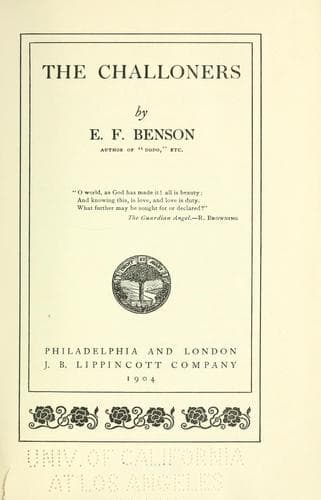
Clergy -- England -- Fiction; England -- Social life and customs -- Fiction; Families -- England -- Fiction
“Well, give me a couple of minutes,” said the outraged Martin. “We
always have an interval after the rot before we begin to talk.
Otherwise, you know, we always laugh. One always laughs at anything
abrupt. Don’t you know the story of the man who was suddenly told his
wife was dead? Just like that. He said, ‘Oh, how shocking!’ and burst
into shrieks of laughter. And he was really devoted to her, and never
smiled again for years.”
Helen gave up all attempts at gravity, and the two foolish twins laughed
till they were completely exhausted, while the Canadian canoe went
slowly circling round and round down the river.
So they landed and lunched, as Martin refused to drag the boat any more
till he had eaten and by degrees recovered themselves. Then, taking to
the canoe again, they paddled and talked.
“It has been dreadful at home, Martin,” said she. “Father hardly speaks
at all. He has been very gentle since that scene with Frank and me, yet
even that was hardly so bad as his silence and quietness now. He is
suffering horribly, too; I am sure of it. Sometimes I see him looking at
me with a sort of appeal in his eyes like a dumb animal. That is the
worst of all; I feel such a brute.”
“You suffer, too,” said Martin, quickly.
“I know; but though they all--Uncle Rupert, Lady Sunningdale--think I am
right, that doesn’t make me feel less of a brute. Besides, there is no
‘right’ about it. I can’t give him up, and father can’t bear it. And
every evening he uses the prayer for Jews, Turks, and infidels.”
Martin frowned.
“That is not good manners,” he said, “with you there.”
“Oh, Martin, manners don’t come into it. The truth of father’s beliefs
is so overwhelmingly real to him that he can’t think of anything else.
That light is so strong that he can see nothing but it. It is soberly
the whole world to him.”
“But it isn’t as if Frank was immoral,” said Martin.
“I believe he would mind that less,” said she.
Martin swung the canoe round a half-submerged tree-trunk, where the
water sucked and gurgled.
“But how unreasonable,” he cried. “Frank can’t help his want of belief.
But we can all, in some degree, help making brutes of ourselves.”
Helen sat up suddenly, causing the boat to rock.
“I can’t live my life on other people’s lines,” she said, “any more than
I expect others to live theirs on my lines. ‘I am I.’ I remember Frank
quoting that to me the Sunday he walked back with me from Chartries.
That has been like leaven; it has fermented and expanded within me. But,
after all, is it only another way of saying ‘I shall be as selfish as I
please’?”
“Of course not. That is what people think who haven’t got any
individuality of their own. Lots of people haven’t. They are like
mirrors slightly cracked, which reflect with certain dimnesses and
distortions what is put opposite them. They say individuality is
selfishness. What bosh!”
Public-domain text, read in full here on John Shaqi.
Reviews
Reviews
No reviews yet
Be the first to share your thoughts on this work.
Elsewhere in the archive
Join the Discussion
Join the discussion
Sign in to leave a comment or review.
Sign InorCreate an account