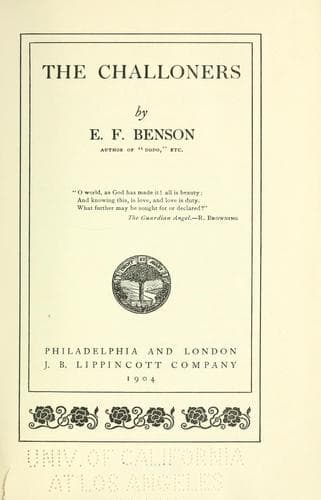
Clergy -- England -- Fiction; England -- Social life and customs -- Fiction; Families -- England -- Fiction
And the pathos of it suddenly moved her. Was that all that the good
fairies had brought to her aunt’s cradle, just to grow quietly and
gently old, she, who might have been so fine, missing all the joy and
riot of life, missing, too, the crown of womanhood? “To live, to live!”
that demand was battering at her doors with buffets that made the panels
start. Yet here was the dear aunt, who had heard often the same
insistent visitor, old, but sweet and unembittered, though it had never
been given to her to let him in, knowing all she had missed, yet not
soured at having missed it.
“Oh, Aunt Susan,” she cried, forgetting herself, forgetting all else in
a young creature’s somewhat insolent pity for the old, “is it not too
sad? Is it not too terribly sad? Is that everybody’s fate, just to get
older and older----“
Then, with the strong, unconscious egotism of her years:
“And me?” she said. “Will that happen to me, too?”
“What? Sadness? Yes, dear Helen, I hope so. No woman is worth very much
until she has been through a good deal of sadness, a great deal of
wanting what she cannot get. I hope you will go through that. But, dear,
if you turn bitter under it, you had almost better not have lived; and
certainly you had better die, for death is better than bitterness. But
if you take the love and the sadness, which is inseparable, from life
without bitterness, it strengthens and cleanses you. And you will
certainly emerge from it a far finer creature than if you had never been
through it. Emerge? Ah, it may last to the day of your death; but what
then? What does that matter?”
There was a long silence, and the shadows grew and lengthened on the
grass as Helen sat unseeing, but absorbed, gazing wide-eyed in front of
her. She felt ashamed, humiliated at her own blindness; she had thought
of her aunt as some dweller in the valley, while she herself was
climbing the snowfields far above with eager, untiring foot. But now at
the summit, or near it, she saw sitting the quiet, patient figure, so
high up that she had not seen her before.
Then, in her gentle voice, Aunt Susan broke in on her reverie.
“There, dear,” she said, “the sun has set; let us go in. And do tell me,
Helen, before you go home, what you decide to do about this very
difficult choice that is before you. Of course, you will not give Lord
Yorkshire up. I think that would be very wrong. Do not be hasty; do not
judge quickly. But do confide in me again, if you can. It is a great
privilege, you know, for old people to be confided in by the young.
Come, it is time to dress; there are a few people to dinner. Ah, Martin
comes, too. I had quite forgotten. Dear me, how careless! I must go and
see if there is enough to eat.”
Helen rose and gave her a great, tempestuous hug.
“You dear, you dear,” she said.
And then Aunt Susan, after her excursion into realities, hurried to the
kitchen, the excellent housekeeper again.
* * * * *
Public-domain text, read in full here on John Shaqi.
Reviews
Reviews
No reviews yet
Be the first to share your thoughts on this work.
Elsewhere in the archive
Join the Discussion
Join the discussion
Sign in to leave a comment or review.
Sign InorCreate an account