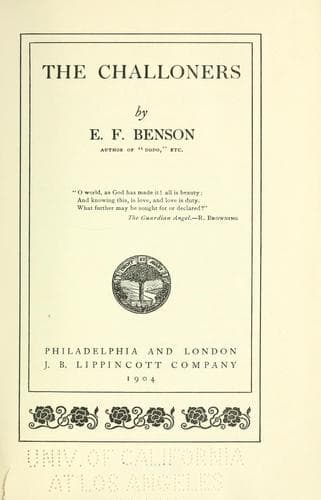
Clergy -- England -- Fiction; England -- Social life and customs -- Fiction; Families -- England -- Fiction
“No; your father is wrong, I think,” said Lady Susan, with gentle
decision. “And now, dear, as you are going away to-morrow, I want to ask
you something. You go home with Martin, do you not? And then? Have you
made up your mind?”
“Yes,” she said. “I will not give up Frank, but I will put it all off
till next May. Of course, if he wishes, he is absolutely free.”
“Ah,” said Aunt Susan, gently. “It is likely he would wish that, I
suppose.”
Helen laughed.
“Well, no; not very. But till then I shall live at home, if father will
let me, and try in every way to please him.”
Her voice trembled a little.
“And I hope he will accept that,” she said. “And I hope he will be good
to me and forgive me.”
Lady Susan stroked her hair in silence a moment.
“You have chosen right, dear,” she said.
CHAPTER IX
Helen was sitting again at the deal table in the “Room,” trying to
balance the accounts of the quarter. A money-box, cheap but not strong,
probably made in Germany, with a florid ornament of tin tacked on round
its maw, stood open by her left hand, and on the table was a heap of
money, consisting chiefly of pennies and small silver coins,--the
subscription to the “Room” being threepence a quarter,--while by her
right hand was a pile of equally mean bills, chiefly ending with a
halfpenny, for brown holland, cotton, slate-pencils, needles, and gum.
There was a discrepancy somewhere of ninepence, but add and subtract as
she would, that ninepence held its ground like the remnant of the Old
Guard. Had it been only deficit, the remedy from her own pocket would
have been easy, but, unfortunately, there was ninepence too much, and,
though her conscience would not have made any protest at her supplying
it, it did not permit her either to pocket it or to forge a non-existent
bill. And all the time her natural impatience, mixed luckily with a
certain sense of humour, said to her, “Is it possible to conceive a less
profitable way of wasting time than in trying to make ninepence vanish?”
Her father, however, with the attention to detail which was so marked a
characteristic of his, always looked over the accounts afterwards, and
whether there was a discrepancy of a thousand pounds or a penny it made
no difference, the principle of admitting discrepancy was equally
dangerous in either case.
Public-domain text, read in full here on John Shaqi.
Reviews
Reviews
No reviews yet
Be the first to share your thoughts on this work.
Elsewhere in the archive
Join the Discussion
Join the discussion
Sign in to leave a comment or review.
Sign InorCreate an account