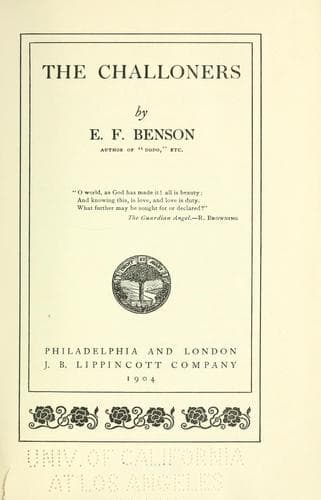
Clergy -- England -- Fiction; England -- Social life and customs -- Fiction; Families -- England -- Fiction
What made things worse was that Martin, the beloved twin, with whom
disagreement was a thing unthinkable, radically disapproved of what she
was doing, and his disapproval, she was afraid, was terribly
practical,--namely, that it was quite certainly no use. Two things,
however, after some three weeks of what seemed fruitless endeavour, kept
her to it. One was a letter from Aunt Susan, to whom she had sent a
despairing sheet, containing a memorable sentence: “God does not always
pay on Saturday, Helen,” she had said. The other was an innate pride
that forbade her to accept defeat. Here she feared also to lose the
respect not only of her father, but of Frank.
“Yes, my darling, you tried it,” she imagined him saying, “and you found
it was doing no good.”
And that he should say that was somehow intolerable to her. Whatever she
might be, she would not be feeble. “The lame and the blind that are
hated of David’s soul” seemed to her a very legitimate object of
detestation. She would not give a thing up because she mistrusted her
power of doing it.
Thus her apparent failure consumed itself. With the divine confidence of
youth, the less successful she seemed to be the more she spurred herself
on to strive. All her sense of right had told her, when she made her
decision, that she would thus be doing her best; her judgment was
arrived at coolly and sanely, and the present practical ill-success of
it argued nothing against the principle.
Then came a crowning despondency and agitation in something Martin told
her after he returned from a visit to Lady Sunningdale. The short
history of that visit, however, claims an episodic precedence.
* * * * *
Lady Sunningdale had sent her motor over from Fareham to fetch Martin,
and when he arrived, about tea-time, he rushed straight out on to the
lawn to find her, but only encountered the chilling looks of several
total strangers who were talking about fiscal problems and seemed
surprised, if not pained, to see him. This was discouraging; and he was
wondering what place there was to flee unto, when a footman came out
after him to say that her ladyship was in her bedroom and wished to see
him there immediately. Martin could not help giving a little giggle of
amusement at this, and the footman, preceding him upstairs, threw open
the door and announced him.
The room was large and very rose-coloured, on the principle of Lady
Sunningdale’s famous maxim that bedrooms should be optimistic. She
herself was reclining on the optimistic silk coverlet of her bed, with
her shoes off and the blinds down.
Public-domain text, read in full here on John Shaqi.
Reviews
Reviews
No reviews yet
Be the first to share your thoughts on this work.
Elsewhere in the archive
Join the Discussion
Join the discussion
Sign in to leave a comment or review.
Sign InorCreate an account