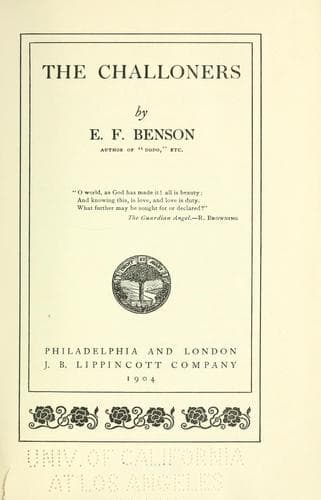
Clergy -- England -- Fiction; England -- Social life and customs -- Fiction; Families -- England -- Fiction
Karl stood in front of the fireplace for some minutes, opening and
shutting his hands, which were a little cramped, a little tired with the
long practise they had just finished. His mind, too, was a little tired
with the monotony of his work, for his three hours at the piano had been
no glorious excursion into the sun-lit lands of melody, but the
repetition of about twelve bars, all told, from a couple of passages out
of the Waldstein Sonata which he was to play next week at the last of
his four concerts in St. James’s Hall. And though perhaps not half a
dozen people in that crowded hall would be able to tell the difference
between the execution of those dozen bars as he played them yesterday
and as he could play them now, he would not have been the pianist he was
if it had been possible for him not to attempt to make them perfect,
whether that took a week or a month. The need of perfection which never
says “That will do” until the achievement cannot be bettered was a
ruling instinct to him.
Besides, to him just now the presence of one out of those possible six
auditors who might be able to tell the difference was more to him than
all the rest of the ringing hall. Sometimes he almost wished he had
never seen Martin,--never, at any rate, consented to give him
lessons,--for in some strange way this pupil was becoming his master,
and Rusoff was conscious that the lad’s personality, never so vivid as
when he was at his music, was beginning to cast a sort of spell over his
own. Brilliant, incisive, full of fire as his own style was, he was
conscious when Martin played certain things that his own rendering, far
more correct, far more finished though it might be, was elderly, even
frigid, compared to the other. The glorious quality of his exuberant
youth, a thing which in most artists is beginning to pale a little
before they have attained to that level of technical skill which is
necessary to a pianist of any claim to high excellence, was in Martin at
its height and its noonday, while it really seemed sometimes to his
master that he had been, perhaps in his cradle, perhaps as he bent his
unwilling head over the crabbed intricacies of Demosthenes, somehow
mysteriously initiated into the secrets of technique. Anyhow, that
facility, that art of first mastering and then concealing difficulties
which to most pianist only comes, as it had come to himself, through
months and years of unremitting toil, seemed to be natural to his pupil.
Martin had only got to be told what to do, and if he was in an obliging
humour he did it. The difficulties of execution simply did not seem to
exist for him. Immensely struck as Karl Rusoff had been with his
performance last summer at Lord Yorkshire’s, he felt now that he had not
then half fathomed the depth of his power, which lay pellucid like a
great ocean cave full of changing lights and shadows, suffused to its
depths with sunlight, and by its very clearness and brightness baffling
Public-domain text, read in full here on John Shaqi.
Reviews
Reviews
No reviews yet
Be the first to share your thoughts on this work.
Elsewhere in the archive
Join the Discussion
Join the discussion
Sign in to leave a comment or review.
Sign InorCreate an account