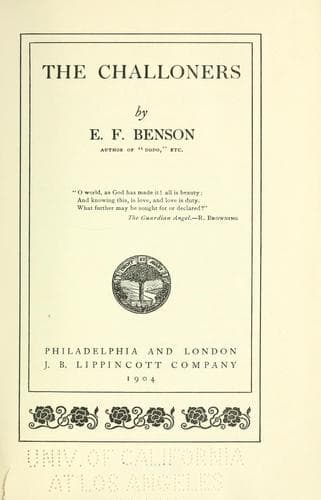
Clergy -- England -- Fiction; England -- Social life and customs -- Fiction; Families -- England -- Fiction
Karl paused a moment, summoning to his aid all that he knew, all he had
ever learned to give cunning to his fingers and perception to his brain.
Never perhaps in his life had he played with more fire, with more
eagerness to put into the music all that was his to put there, and that
in order to charm no crowded hall packed from floor to ceiling, but to
show just one pupil the difference between playing the music and playing
the notes.
Martin had left the music-stool in what may be called dignified silence
and was standing by the fire; but before long Karl saw him out of the
corner of an eye (he could spare him neither thought nor look) steal
back towards the piano, and though he could not look directly at his
face, he knew what was there,--those wide-open, black eyes,
finely-chiselled nostrils, swelling and sinking with his quickened
breath, mouth a little open, and the whole vivid brain that informed the
face lost, absorbed.
He came to the end and sat silent.
“Is that there?” asked Martin, in a half-breathless whisper. “Is that
really all there?”
Karl looked up. Martin’s face was exactly as he had known it would be.
But the first mood of the artist was of humility.
“I played wrong notes,” he said. “Half a dozen at least.”
“Oh, more than that,” said Martin. “But what does that matter? You
played it. My God, what a fool I have been! There I sat, day after day,
and never saw the music.”
Karl Rusoff got up. It had been a very good music-lesson.
“It isn’t ‘stodgy,’” he said. “It isn’t, really. Do you now see one
thing out of a hundred perhaps that it means? You have got to be the
critic of the music you play,--you have to interpret it. But out of all
the ways of playing that, out of all that can be seen in it, you saw
nothing, your rendering was absolutely without meaning or colour. To
play needs all you are; you gave that fingers only. If I want you to
practise fingers only, I will tell you so, and give you a finger
exercise or Diabelli. Otherwise you may take it for granted that when
your fingers are perfect your work begins. But to play--ah--you have to
burn before you play.”
Martin still hung over the piano.
“And I thought it stodgy,” he repeated, looking shy and sideways at
Karl’s great grey head.
“Well, you won’t again,” said he. “Will you try it again now?”
“No; how can I?” said Martin. “I’ve got to begin it all over again.”
“Then there was a piece of Bach. Play that. And now read nothing into it
except the simplicity of a child. Just the notes,--the more simply the
better. Wait a moment, Martin. I want to enjoy it. Let me sit down.”
Public-domain text, read in full here on John Shaqi.
Reviews
Reviews
No reviews yet
Be the first to share your thoughts on this work.
Elsewhere in the archive
Join the Discussion
Join the discussion
Sign in to leave a comment or review.
Sign InorCreate an account